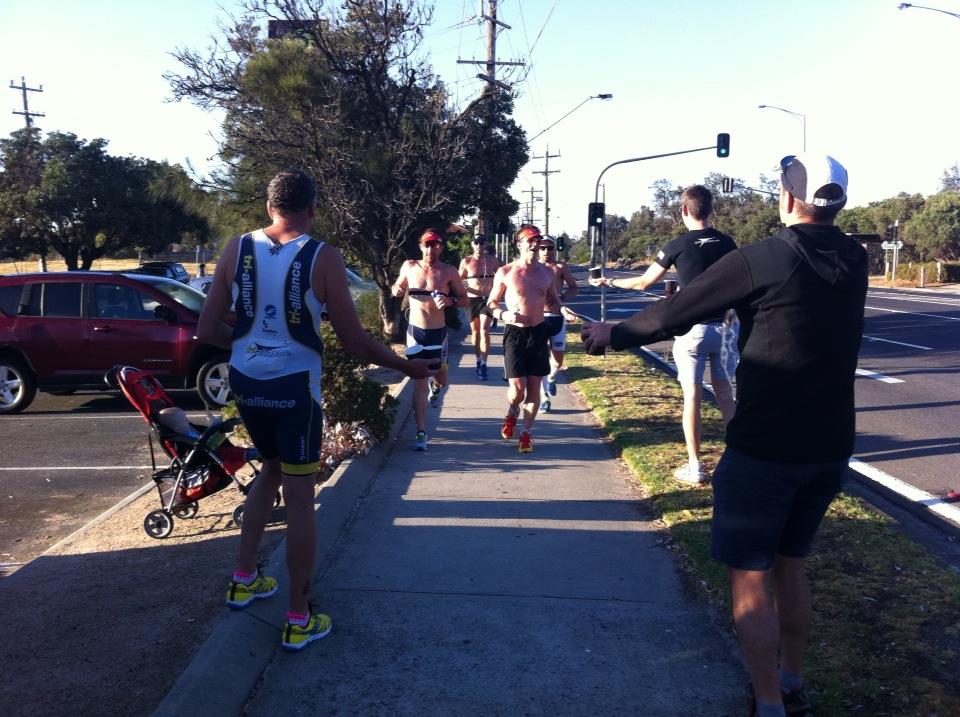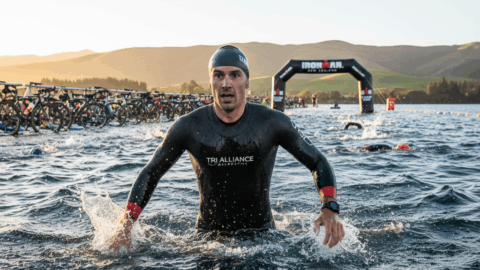


Recovery week is not the week nothing happens. It is the week the last three weeks of work finally turn into fitness, and it is the runway for the sharpest block of training we have done since the season started. From next week, Tri Alliance sessions shift towards speed and threshold work.
The short version
- This week is recovery. Reduced load, not a week off.
- Next week the sessions get sharper. Speed and threshold become the focus.
- Your first sharp session gives you a benchmark number. Write it down.
- Hard days hard, easy days genuinely easy. That contrast is the whole mechanism.
Why the phase changes in September
September marks the start of spring, and less than three months before the Melbourne triathlon season kicks into action. The winter job was aerobic base: volume, consistency, technique and strength. That work raises your ceiling, but on its own it does not make you fast.
Base training teaches your body to produce energy efficiently for a long time. Speed and threshold training teaches it to hold a genuinely hard pace without falling apart. They are different skills, and you need both.
Leave the sharpening too late and you arrive at your first race fit but flat, able to go all day and unable to go hard. Start it too early and you cook yourself in October for a race in December. Late September is the right window, which is exactly where we are.
What threshold actually is
Your threshold is roughly the hardest effort you could hold for about 40 to 60 minutes flat out. Below it, your body clears the by-products of hard work about as fast as it makes them, so you can keep going. Above it, the maths stops working and the clock starts running out on you.
Push your threshold up and every pace below it becomes cheaper. Your steady ride feels easier, your long run settles quicker for the same effort, and race pace stops being a negotiation.
That line is trainable, and lifting it is the single biggest return on investment available to you between now and the season opener.
What it looks like for you
The phase is the same for everyone. The emphasis is not.
Short course athletes
More threshold. Shorter, sharper efforts held at a controlled hard pace, with structured recoveries. Your racing is largely run at or near this intensity, so this is your specificity.
Long course athletes
Endurance stays the backbone, with threshold work built into it. The aim is to lift the pace you can hold aerobically, not to turn every session into a race.
Athletes new this season
Stay with triathlon specific work: base fitness, technique and skills. Speed is built on top of consistency, not instead of it. You will feel the sessions get sharper without needing to chase every interval.

You cannot improve what you never measured
Threshold training only works if it is done at the right intensity, and the right intensity is personal. Training off how you feel on the night is how athletes end up in the grey zone: too hard to recover from, too easy to drive adaptation.
So the block starts with a number. Early in the block your coaches will set a time trial over a fixed distance on a flat, measured loop, run under conditions you can repeat. Whatever you run, write it down. It is not a test you pass or fail. It is the reference point every threshold run in the coming weeks is built from, and the number we repeat later to prove the block worked. Two data points, weeks apart, are worth more than any amount of guessing.
Easy has to be easy
The most common way athletes waste a speed block is not the hard sessions. It is the easy ones. If your recovery runs and steady rides creep up in intensity, you arrive at the hard session already tired, do it at eighty percent of what you were capable of, and then recover from it slowly. Repeat that for six weeks and you get fatigue without fitness.
Hard days hard. Easy days genuinely easy. That contrast is the whole mechanism, and it is what this week is about.
How to use recovery week
Adaptation does not happen during the session. It happens in the hours and days afterwards, when the body repairs and rebuilds on top of what it was before. Recovery week is when that backlog gets cleared.
Your recovery week checklist
- Do not top up the volume. If a morning session is not programmed, that is deliberate. Filling the gap with your own session converts a recovery week into an ordinary week.
- Sleep is the session. An extra hour across the week will do more for the next block than any bonus ride.
- Keep eating properly. Lower volume is not a reason to under fuel. Repair costs energy.
- Deal with the niggle. The small thing you have been managing for a month is far cheaper to fix this week than in the middle of a speed block.
- Turn up to the sessions that are on. Recovery week is reduced, not cancelled, and the squad is where the consistency comes from.
What to expect next week
Build Week 1 brings the intensity back with structure: defined efforts, defined recoveries, and a clear target for each session rather than “go hard”. Expect the warm ups to matter more, the recoveries between efforts to be treated as part of the session rather than a break from it, and your coaches to talk in paces and efforts rather than distances alone.
Come into it rested. Come in with a benchmark number of your own. Come in knowing what the block is for. That is how three months of winter becomes race day speed.
Discover more from Tri Alliance Triathlon Community
Subscribe to get the latest posts sent to your email.