
Twelve weeks of honest running might take two minutes off your 10 km. It will cost you three sessions a week, a good deal of soreness, and every scrap of consistency you can find.
There are two minutes sitting on the ground in the middle of your next race, and almost nobody bends down to pick them up.
They are in transition. T1, swim to bike. T2, bike to run. Put a stopwatch on an athlete who has never practised them and you will usually see somewhere between three and five minutes spent across the two. Put the same watch on someone who has rehearsed a simple routine half a dozen times and it is under two. That difference is free. It adds no training load, needs no recovery, and does not care in the slightest how fit you are.
And the clock is not even the main argument.
What actually goes wrong in transition
Watch a first-timer in T1 and you will not see someone moving slowly. You will see someone deciding. Wetsuit stuck on one ankle. Helmet in one hand, sunglasses in the other, no idea which goes first. Two laps of the rack looking for a bike that was definitely near the blue towel, except there are now forty blue towels.
None of that is fitness. All of it is trying to hold a sequence in your head at a heart rate of 170, in bare feet, with your hearing muffled and someone else’s elbow in your ribs. Working memory is the first thing that goes.
So the goal is not to be fast in transition. The goal is to arrive with nothing left to decide.
Set the towel up the same way, every single time
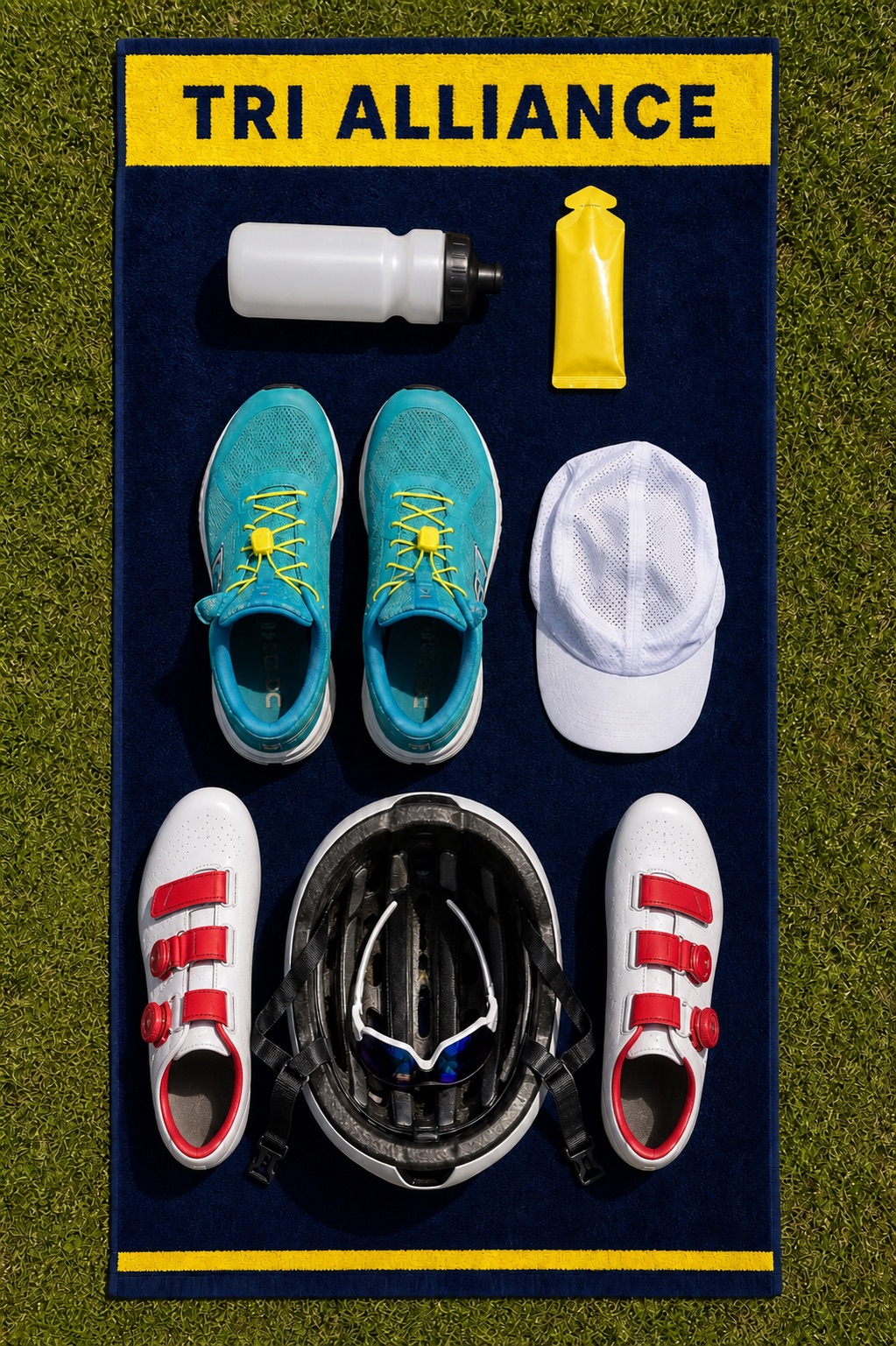
One towel, and a small one. Everything on it, in the order you will touch it, and nothing else. A tub of gear is not preparation, it is a search problem you have scheduled for yourself at the worst possible moment.
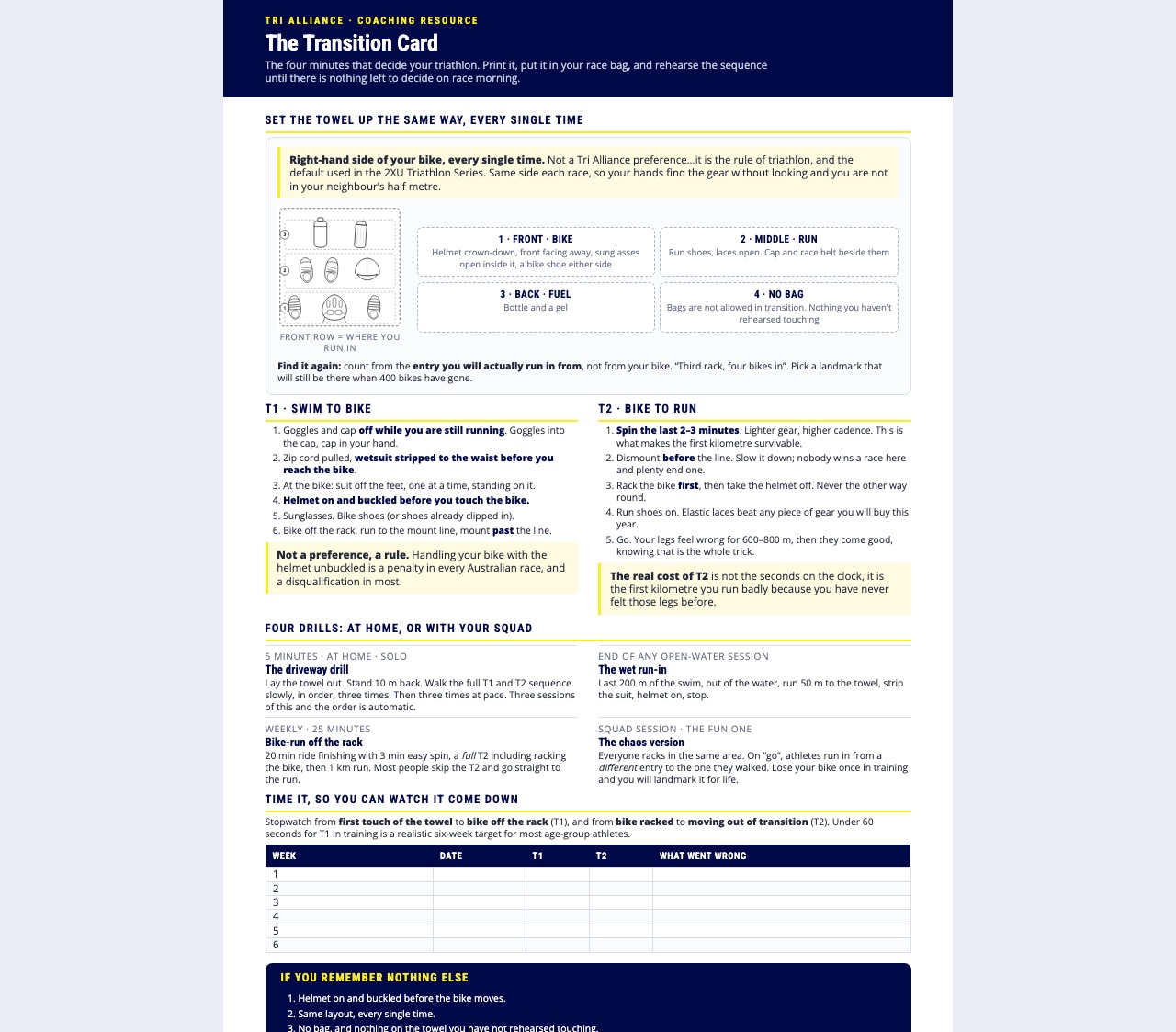
And it goes on the right-hand side as you look at your bike. Same side, every single time. This is not a Tri Alliance preference. It is the rule of triathlon. A handful of races leave it ambiguous, but right-hand side is the default, and it is what the 2XU Triathlon Series runs on, so it is the one to train. The reason is not neatness. In a full rack you have about half a metre and your neighbour has the same; if everyone picks their own side, two athletes end up fighting over one strip of grass while the clock runs. Pick the right, stop deciding, and let your hands learn where everything is so you can run the sequence without looking down.
- Front row, the bike. Helmet upside down, crown on the towel and opening up, with the front of the helmet near the front edge of the towel, so when you flip it on the front lands at your forehead. Sunglasses open, sitting inside it. One bike shoe either side.
- Middle row, the run. Run shoes, elastic laces, tongues pulled open. Cap beside them.
- Back row, fuel. Bottle and a gel, and nothing you have to open with your teeth while moving.
- No bag. Bags are not allowed in transition. If you have not rehearsed touching it, it does not come in with you.
Then the part everyone skips: how you will find it again. Count from the entry you will actually run in from, not from where you walked in this morning. “Third rack, four bikes in”. Pick a landmark that will still be standing when four hundred bikes have left. A bright towel is not a landmark. A light pole is.
T1, swim to bike
The work starts before you are out of the water.
- Goggles and cap off while you are still running. Goggles into the cap, cap into your hand. Doing it standing at your bike costs you eight seconds and both hands.
- Zip cord pulled and the wetsuit stripped to the waist before you reach the rack. You have a hundred metres of running to do it in. Use them.
- At the bike, suit off the feet, one at a time, standing on it. Do not sit down. Nobody who sits down gets up quickly.
- Helmet on and buckled before you touch the bike.
- Sunglasses. Shoes.
- Bike off the rack, run to the mount line, and mount past it.
Step four is not a preference, it is a rule. Handling your bike with the helmet unbuckled is a penalty in every Australian race and a disqualification in most of them. It is also, reliably, the thing an excited first-timer forgets.
T2, bike to run: shorter, and more painful
T2 has fewer steps and costs more, because it is where the race hurts.
- Spin the last two or three minutes of the bike. Lighter gear, higher cadence, less force. This single habit does more for your first kilometre than anything you will do in T2 itself.
- Dismount before the line, and slow it down. No race has ever been won at the dismount line. Plenty have ended there.
- Rack the bike first. Helmet off after the bike is racked, never before.
- Run shoes on. Elastic laces will do more for your race than any piece of equipment you buy this year.
- Go. Your legs will feel wrong for six to eight hundred metres, and then they will come good. Knowing that in advance is most of the trick.
Four drills you can do at home, or take to your squad
1. The driveway drill: five minutes, on your own
Lay the towel out on the driveway or the lounge room floor. Stand ten metres back. Walk the whole T1 and T2 sequence, slowly and in order, three times. Then do it three times at pace. That is the entire drill. Three sessions of it and the order stops being something you remember and starts being something you do.
2. The wet run-in: the end of any open-water session
Last two hundred metres of the swim, out of the water, run fifty metres to a towel on the grass, strip the suit, helmet on. Stop there. You are rehearsing the handling, not the effort.
3. Bike-run off the rack: once a week, twenty-five minutes
Twenty minutes on the bike finishing with three minutes of easy spinning, then a full T2 including actually racking the bike, then one kilometre of running. Most people doing brick sessions skip straight from the bike to the run, which means they rehearse the easy half and never touch the part that costs them.
4. The chaos version: a squad session, and the fun one
Everyone racks in the same area. On “go”, athletes run in from a different entry to the one they walked in through. Lose your bike once in training, with your squad laughing at you, and you will landmark it properly for the rest of your life.
Time it, so you can watch it come down
Stopwatch from first touch of the towel to bike off the rack for T1, and from bike racked to moving out of transition for T2. Write both down. Under sixty seconds for T1 in training is a realistic six-week target for most age-group athletes, and watching that number fall is far more motivating than it has any right to be.
If you remember nothing else
- Helmet on and buckled before the bike moves.
- Same layout, every single time.
- Nothing on the towel you have not rehearsed touching.
Discover more from Tri Alliance Triathlon Community
Subscribe to get the latest posts sent to your email.