
Sam Laidlow sets world’s fastest time at Challenge Roth is the headline, but the more useful lesson for Melbourne triathletes is how he did it: a front-foot swim-bike race that created enough space to survive one of the fastest marathons ever run in long-course racing.
According to Triathlete, Laidlow won in 7:21:04, with splits of 46:57 swim, 3:54:58 bike and 2:36:53 run. In the women’s race, Alanis Siffert produced a career-best breakthrough, winning in 8:09:09 after a 4:29:19 bike split and a 2:45:00 marathon.
For athletes training through a Melbourne winter, this was not just a European race result. At Tri Alliance, our athletes hear this lesson often: long-course racing rewards discipline before it rewards heroics. That means swim position, bike control, pacing under pressure, and the mental skill to keep executing when the race becomes uncomfortable.
Sam Laidlow Sets World’s Fastest Time: The Key Numbers
Laidlow’s 7:21:04 lowered the full-distance benchmark reported by Challenge Roth by 20 seconds, bettering Kristian Blummenfelt’s 7:21:24 from April 2026. Challenge Roth also reported a course-side crowd of 300,000 spectators, which matters because the energy of Roth is part of why the race can produce extraordinary performances.
| Athlete | Result | Swim | Bike | Run | Overall |
|---|---|---|---|---|---|
| Sam Laidlow | Men’s winner | 46:57 | 3:54:58 | 2:36:53 | 7:21:04 |
| Kristian Blummenfelt | Men’s second | 49:54 | 4:04:10 | 2:29:33 | 7:26:24 |
| Rico Bogen | Men’s third | 46:56 | 3:54:45 | 2:43:48 | 7:27:53 |
| Alanis Siffert | Women’s winner | 52:03 | 4:29:19 | 2:45:00 | 8:09:09 |
| Lucy Charles-Barclay | Women’s second | 50:23 | 4:31:51 | 2:50:43 | 8:16:41 |
The men’s race was especially instructive because Blummenfelt ran 2:29:33 and still finished more than five minutes behind Laidlow. That is the coaching point: a brilliant run can win a race only if the athlete has not given away too much position and control before T2.
What Melbourne Triathletes Should Take From Roth
Melbourne athletes do not need to copy world-record pacing. They need to copy the decision-making. Roth showed that the race can be shaped before the marathon, and that winter is the right time to build the habits that make that possible.
If you are training around MSAC pool sessions, Beach Road rides, Albert Park laps, wind-trainer work and dark winter mornings, the lesson is not “go harder”. The lesson is to make the hard work more deliberate.
1. Swim Position Still Matters
Laidlow was part of the front men’s swim group, and Triathlete reported that the gap to Blummenfelt had grown to around three minutes by the end of the swim. That did not decide the race by itself, but it changed the shape of the day.
For age-groupers, the equivalent is not trying to swim like a professional. It is turning up to squad with a clear target: cleaner body position, fewer dead spots, better breathing control and the ability to exit the water settled rather than spiked. A simple winter benchmark is to hold repeatable 100m splits in the pool before chasing speed in open water.
Local context matters here. State Sport Centres lists adult lap swim entry at MSAC at AUD $8.50, so even one extra focused technique swim per fortnight can be a realistic winter investment for athletes who are not ready to add more volume.
2. The Bike Is Where The Race Becomes Honest
The splits show just how extreme the front of the race became: Laidlow rode 3:54:58, while Bogen rode 3:54:45. Those numbers are not training targets for age-group athletes, but they do underline a principle: the bike leg rewards athletes who can hold pressure without letting effort become chaos.
In Melbourne winter, that is exactly what indoor riding is for. Wind-trainer sessions should not become random suffering. They should practise steady power, position discipline, cadence control and the patience to ride the prescribed effort even when the screen, group or ego says otherwise.
Use your Tri Alliance wind-trainer sessions as a place to rehearse control. The athlete who can hold the right effort indoors in July is building the athlete who can make better decisions outdoors in November.
3. Running Fast Off The Bike Starts Before The Run
Siffert’s 2:45:00 marathon was decisive because it followed a bike leg that put her in command. Laidlow’s race tells the same story from a different angle: he did not need the fastest marathon of the day because his swim-bike work had already created enough margin.
For local athletes, this is where long-course pacing gets real. A strong run off the bike is rarely built by smashing every winter run. It comes from consistent aerobic running, controlled brick sessions, and learning not to over-ride early.
If you are targeting a 70.3 or Ironman build, connect your run work to a structured week rather than adding random kilometres. Start with the Tri Alliance long-course training options and make sure the run has a job inside the whole program.
Winter Training Phase: How To Apply The Roth Lesson This Week
The practical takeaway is simple: use winter to become harder to disrupt. Laidlow and Siffert performed when the pressure was high because their race execution had layers. Melbourne athletes can build those layers now.
| Winter focus | What to practise | Melbourne example |
|---|---|---|
| Pool control | Repeatable 100m pacing, body position, sighting skills | Technique-focused squad swim or extra MSAC lap session |
| Indoor bike discipline | Steady power, cadence changes, aero-position tolerance | Structured wind-trainer set instead of random threshold riding |
| Run durability | Easy aerobic consistency, short bricks, form under fatigue | Controlled Albert Park or Fairfield run, not every run as a race |
| Mental toughness | Holding the plan when bored, cold, tired or under pressure | Arriving prepared for dark winter sessions and completing the set |
Roth is famous for speed, but the athlete lesson is not only speed. It is execution. If the session says aerobic, stay aerobic. If the bike interval says controlled, stay controlled. If the swim set asks for repeatable pacing, stop turning every lane into a final.
What This Means For Your Next Training Block
A world-best performance can make ordinary training feel distant, but the opposite should happen. The more elite the race, the clearer the fundamentals become. Position early. Ride with purpose. Run from a platform, not from panic. Keep making good decisions when the race becomes noisy.
That is the winter assignment. Use the cold months to build repeatable habits. Know your pool paces. Know your bike zones. Know what an honest easy run feels like. Practise the small things before race season asks for them all at once.
For structured Melbourne squad support, start with the Tri Alliance training overview and check the current training timetable. The goal is not to copy Roth splits. The goal is to build the version of you that can execute your own race plan when it matters.
FAQ
What time did Sam Laidlow do at Challenge Roth 2026?
Sam Laidlow won Challenge Roth 2026 in 7:21:04. His reported splits were 46:57 swim, 3:54:58 bike and 2:36:53 run.
Did Sam Laidlow set the world’s fastest full-distance triathlon time?
Challenge Roth reported Laidlow’s 7:21:04 as a world record over the 3.8km swim, 180km bike and 42.2km run distance, lowering Kristian Blummenfelt’s April 2026 mark by 20 seconds.
Who won the women’s race at Challenge Roth 2026?
Alanis Siffert won the women’s race in 8:09:09. Triathlete reported her splits as 52:03 swim, 4:29:19 bike and 2:45:00 run.
What can Melbourne age-group triathletes learn from Roth?
The biggest lesson is execution. Build swim position, bike discipline and run durability through winter so that race-day decisions are calmer and more automatic.
Should age-group athletes train like Laidlow or Siffert?
No. Age-group athletes should not copy elite splits or load. Use the race as a model for priorities: front-end swim control, measured bike work, and a run built from consistent training.
Sources checked: Triathlete race report, Challenge Roth official news, PTO Challenge Roth results history, State Sport Centres MSAC pricing.
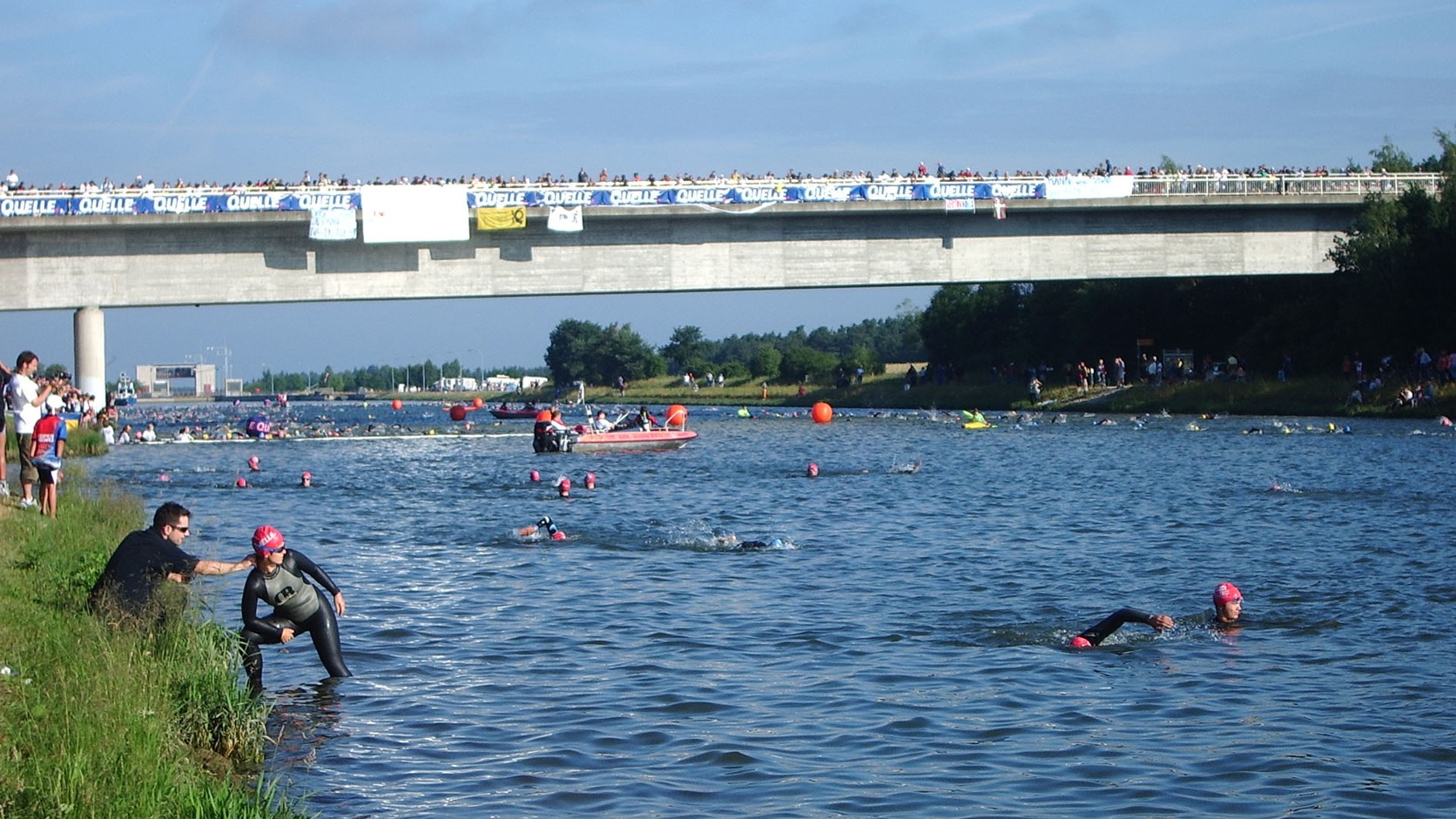
Feature image: Challenge Roth long-distance swim, Main-Donau Canal. Photo: GS / Wikimedia Commons, licensed under CC BY-SA 3.0. Cropped to 16:9.
Discover more from Tri Alliance Triathlon Community
Subscribe to get the latest posts sent to your email.