
Swimming Techniques to Improve Efficiency and Speed
Swimming techniques to improve triathlon efficiency start with one goal: move more water backwards while wasting less energy forwards. For most age-group triathletes, the fastest swim gains do not come from thrashing harder. They come from better body position, a stronger catch, calmer breathing and a repeatable rhythm that still works when the lane rope disappears and the water gets choppy.
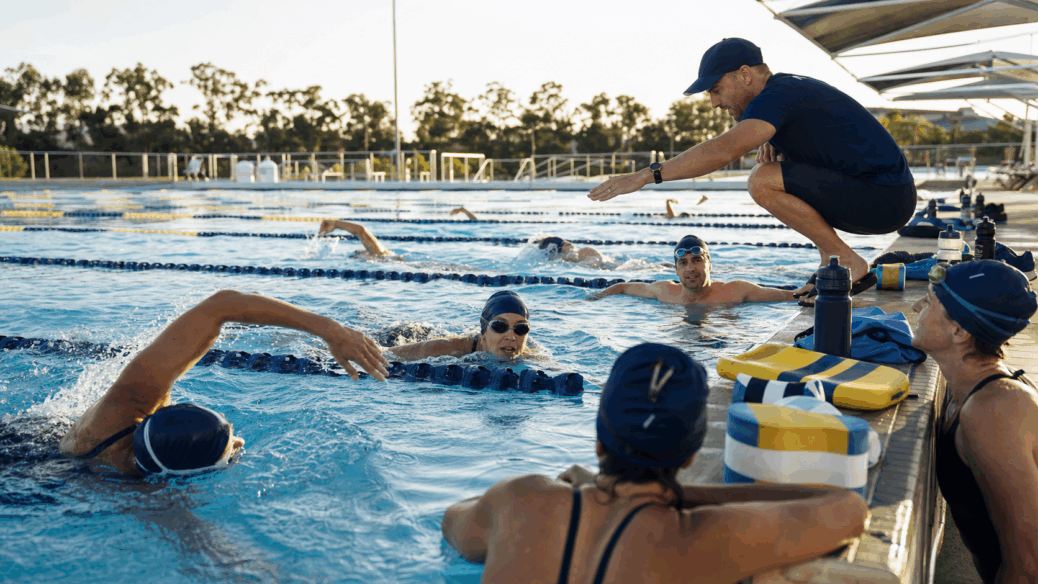
That matters in Melbourne triathlon training because the swim is rarely just a pool time trial. You might be at MSAC working on technique one day, then at Elwood dealing with chop, glare and athletes around you the next. A good stroke needs to be efficient enough for the pool and robust enough for open water.
The Coach’s Framework: Drag First, Power Second
If you want to swim faster, reduce drag before you add power. A low-drag body line lets the same fitness produce more speed. A high-drag body line turns every extra effort into turbulence, shoulder fatigue and a rising heart rate before the bike even starts.
Use this order when you are fixing your stroke:
- Body line: head neutral, hips high, spine long.
- Catch: forearm and hand press water backwards, not down.
- Breathing: exhale underwater, rotate to breathe, avoid lifting the head.
- Timing: smooth rotation, compact kick, stable rhythm.
- Open-water skills: sighting, drafting, buoy turns and contact tolerance.
Do not fix everything in one session. Pick one technical cue for the main set and measure whether it changes your feel, stroke count or pace.
Technique 1: Set a Long, Quiet Body Line
The fastest triathlon swimmers look calm because their body sits high and narrow in the water. Your head should feel heavy and relaxed, with your eyes looking slightly forward and down. If you lift your face, your hips drop. If your hips drop, every stroke has to climb uphill.
A simple test is the push-off glide. Push off the wall, hold streamline and notice whether your legs sink immediately. If they do, work on head position, core tension and gentle kick timing before adding more arm effort.
| Fault | What It Feels Like | Fix |
|---|---|---|
| Head too high | Hips and legs sink | Look down, keep waterline near crown of head |
| Cross-over entry | Snake-like body path | Enter hand in line with shoulder |
| Wide scissor kick | Legs split during breathing | Rotate from hips, keep kick compact |
Technique 2: Build an Early Vertical Forearm Catch
The early vertical forearm, often called EVF, is where real swim speed starts. The aim is to anchor the hand and forearm against the water, then move the body past that anchor. If your elbow drops and your hand slips down, you are pushing water toward the pool floor instead of behind you.
Think of the catch as a patient movement. Enter, extend, tip the fingertips slightly down, keep the elbow high and press the forearm back. The first half of the pull should feel controlled, not rushed.
Set to try: 8 x 50m as 25m scull plus 25m freestyle, with 15 seconds rest. On the freestyle length, keep the same forearm pressure you felt during the scull. If your stroke rate jumps but the pressure disappears, slow down and reset.
Technique 3: Breathe Without Breaking Your Stroke
Many triathletes lose more speed breathing than they gain from extra fitness. The common mistake is holding the breath, lifting the head, then rushing the next two strokes. That creates tension and makes the stroke fall apart under pressure.
Exhale steadily underwater. Rotate to breathe with one goggle in the water, take a quick sip of air, and return the head before the recovering hand enters. You should feel the breath fit inside the stroke, not interrupt it.
- Use bilateral breathing in training to keep the stroke balanced.
- Use your strongest breathing side in racing when chop or sun demands it.
- Practise breathing every 2, 3 and 4 strokes so you can adapt under load.
Technique 4: Use Rotation, Not Shoulder Muscle
Efficient swimming uses body rotation to lengthen the stroke and protect the shoulders. If you swim flat, the arm has to do too much work by itself. If you over-rotate, you wobble and lose the catch. The target is controlled rotation from the hips and torso, with the shoulders following naturally.
A good cue is zip the ribs past the water. As one arm catches, the opposite side rotates forward. You should feel connected from fingertips to lats to core, not like the shoulder is yanking alone.
Drill: 6 x 50m as 6-kick switch. Hold one arm forward, kick six times on your side, then switch. Keep the lead hand quiet and the head still. This teaches balance and timing before you return to full stroke.
Technique 5: Make the Kick Useful, Not Expensive
Triathletes do not need a sprint swimmer’s kick, but they do need legs that stabilise the body. A huge kick can burn matches you need for the bike and run. A dead kick can let the hips sink. The sweet spot is compact, rhythmic and connected to rotation.
For long-course athletes, use a two-beat or relaxed six-beat kick depending on pace. For sprint and Olympic racing, you may hold a firmer kick during surges, starts and buoy exits. The kick should help the stroke; it should not become the workout.
Open-Water Skills That Save Time
Pool speed is only useful if it survives open water. Triathlon swimming adds sighting, contact, drafting and turns. These are skills, not personality traits. Nervous swimmers improve when they practise them deliberately.
- Sighting: lift the eyes only, breathe after the head returns to the side.
- Drafting: sit on the feet or hip of a slightly faster swimmer in training sets.
- Buoy turns: shorten the stroke rate into the turn, then lengthen again after exit.
- Contact: practise close swimming in controlled squad sets so race contact is less shocking.
At Elwood or similar open-water venues, use landmarks before you start. Know the buoy, the exit point and a larger object behind the turn marker. If you only sight for the buoy, you may lose it in chop or glare.
A Weekly Technique Set for Triathletes
This set works well as a technique-focused session inside a normal triathlon week. Keep the pace controlled. The point is cleaner mechanics, not proving fitness.
| Set | Distance | Purpose |
|---|---|---|
| Warm-up | 300m easy | Relax breathing and body line |
| Drill block | 8 x 50m | Scull, fingertip drag, 6-kick switch |
| Main set | 10 x 100m | Hold stroke count within 1-2 strokes |
| Open-water skills | 8 x 25m | Sight twice per lap without lifting the head |
| Cool-down | 200m easy | Reset length and breathing |
Measure progress with stroke count, perceived effort and repeatability. If you swim the first 100m beautifully and the eighth 100m falls apart, the technique is not race-ready yet.
Not For You: When Technique Work Is Not Enough
This article is not a replacement for individual stroke analysis if you have shoulder pain, major asymmetry, panic in open water or a history of swim-related injury. In those cases, get a coach to watch you from deck level and, ideally, underwater. A small correction in hand entry or rotation can be hard to feel but obvious to a trained eye.
Coach Checklist for Technique Transfer
As a coach, I use this checklist when athletes ask which swimming techniques to improve first. The best swimming techniques to improve race-day speed are the ones that transfer from drills into normal freestyle, under fatigue, with other swimmers around you.
- Use swimming techniques to improve body position before adding harder intervals.
- Use swimming techniques to improve catch pressure when pace feels flat.
- Use swimming techniques to improve breathing control when the session gets uncomfortable.
- Use swimming techniques to improve open-water confidence before the first race of the season.
FAQ: Swimming Techniques to Improve Triathlon Speed
What is the fastest way for triathletes to improve swim efficiency?
Fix body position first, then improve the catch. A high body line and early vertical forearm usually produce more speed than simply increasing stroke rate.
How often should I do swim drills?
Include drills in every swim warm-up, but keep them purposeful. Ten minutes of focused drill work is better than thirty minutes of random drills with no transfer to full stroke.
Should triathletes breathe bilaterally?
Yes in training, because it builds symmetry and adaptability. In racing, breathe to the side that gives you cleaner air and better control in the conditions.
How do I know if my catch is improving?
Your stroke count should drop or stay stable at the same pace, and you should feel pressure on the palm and forearm rather than slipping through the front of the stroke.
Do I need a strong kick for Ironman swimming?
You need an efficient stabilising kick, not a costly sprint kick. Save the big kick for starts, turns, surges and the final approach to exit.
The Bottom Line
The best swimming techniques to improve triathlon speed are not tricks. They are repeatable habits: long body line, firm catch, calm breathing, controlled rotation, useful kick and open-water skills practised before race day. Build those into your weekly training and you will exit the water fresher, not just faster.
For a focused next step, the Tri Alliance triathlon swim kick protocol turns an efficient stabilising kick into measurable MSAC race-pace and open-water drills.
Discover more from Tri Alliance Triathlon Community
Subscribe to get the latest posts sent to your email.