


The 10% rule is the boring-sounding training guardrail that quietly saves more endurance seasons than DNFs do. Used well, it keeps you healthy across swim, bike and run without leaking fitness. Ignored, it puts dedicated athletes in the physio queue by week four.
Coach’s quick read
The rule
Increase one training lever by about 10% at a time.
The risk
Stacking swim, bike, run and intensity in the same week.
The fix
Let recovery absorb the work before you chase more load.
There is an athlete on every squad list who has the same story.
They show up to Monday morning feeling great. Felt great all weekend, actually. So great that on Saturday they did the long ride, then bolted on an extra hour with a mate. On Sunday they did the long run, except they pushed the pace, because, well, they felt good.
By Wednesday they are hobbling.
By Friday they are sitting in a physio waiting room being told they have an Achilles strain, a tight ITB, a niggle in the calf, a back that has finally objected.
What happened in between? Good intentions met no recovery, and the body did what it always does. It sent the bill late.
This is what the 10% rule is designed to prevent. It is one of the most boring-sounding rules in endurance sport, and quietly, year after year, it saves more seasons than any race-day pacing strategy ever has.
What is the 10% rule in endurance training?
The 10% rule is a guardrail, not a religion.
In its simplest form, it says do not increase your weekly training load (volume, intensity or frequency) by more than about ten percent week on week.
That is it.
Ten percent more swimming. Ten percent more cycling. Ten percent more running. Not all three. Not stacked. Not in the same week.
It is the practical rule of thumb behind a more important equation that every Tri Alliance coaching decision flows out of:
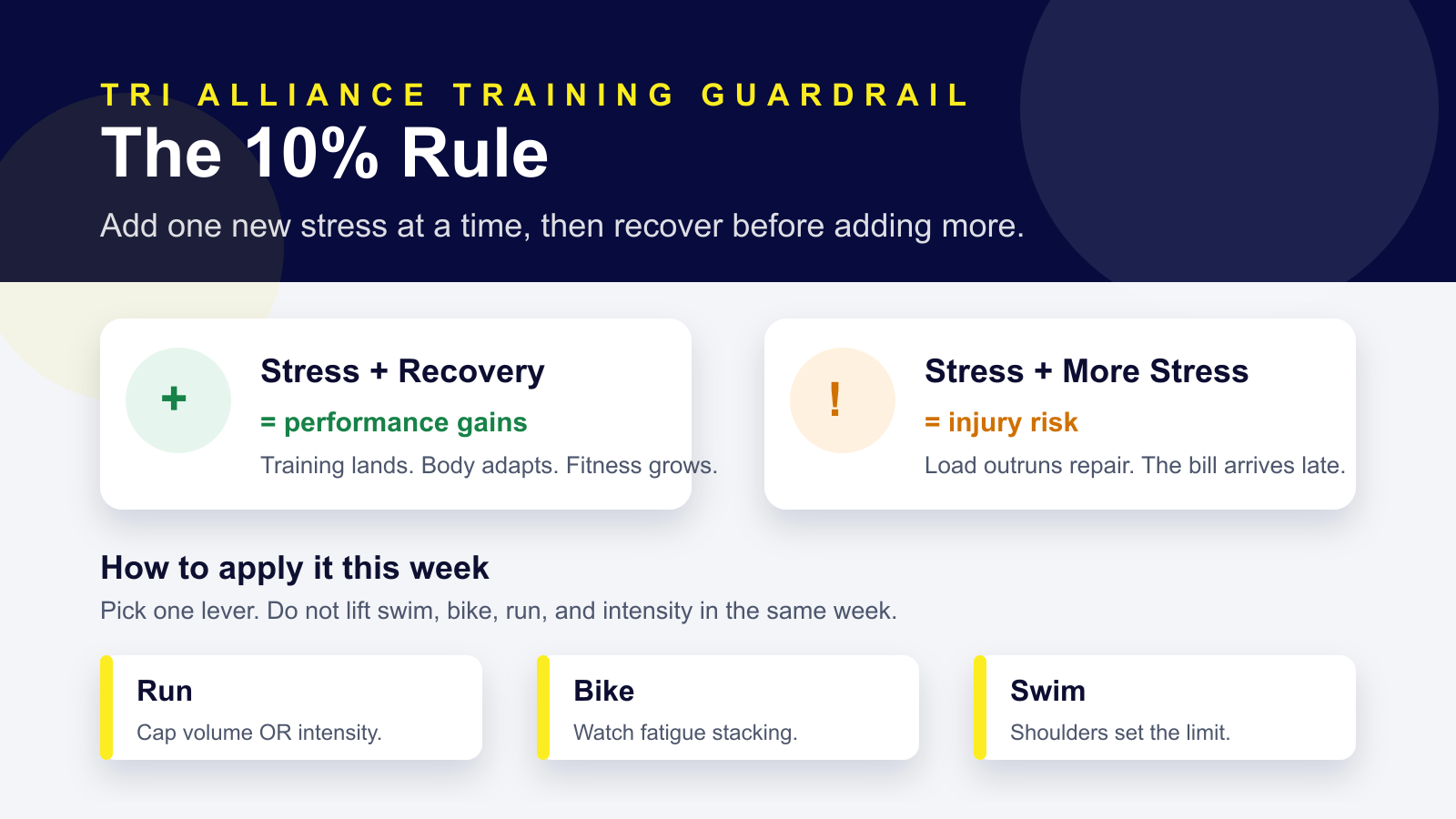
Stress + Recovery = Performance Gains. Stress + more stress = injury, regression or burnout.
The 10% rule is the number you can hang the second part of that equation on. Push new stress harder than that and you do not build fitness. You build damage that has not shown up yet.
Why does the 10% rule actually work?
The reason athletes keep getting caught by overload is that the body has a lag.
You can get away with a big week. You can get away with two big weeks. Sometimes three. Then on the easy day of week four, something gives (a calf, an Achilles, a knee, a back) and the athlete looks down at their watch and says: “but I didn’t even do anything today.”
Today was not the problem. The problem was three Saturdays ago.
The 10% rule works because it stays inside the body’s ability to adapt week on week. Below that line, connective tissue, muscle and the nervous system can recover and rebuild stronger. Above that line, the load arrives faster than the repair, and the deficit compounds quietly until something breaks.
How do “good intentions” turn into overtraining injuries?
Almost no one overtrains on purpose. The athletes we see hurt themselves are the most dedicated ones. They care, they want to be better, they want to make the most of feeling good. That is exactly what makes them vulnerable.
“Wanting to be better” without a system is just creep. Four things drive the creep, and they are usually the same four things.
1. Too many goals
The athlete who wants to swim faster and PB a half marathon and nail a gravel event and keep up with squad. Each goal is fine on its own. Stacked together, the load is impossible to recover from. Your body cannot periodise four peaks at once. Pick one A-goal, support it with one or two B-goals, and let the rest sit.
2. FOMO
You did not plan to ride long this weekend. Then you saw someone on Strava do four hours. Now you feel behind. So you go long. Unplanned long.
That is the killer. The unplanned addition, justified by what someone else did.
3. Not enough discipline on easy days
Most overuse injuries do not come from the hard sessions being too hard. They come from the easy sessions being too hard.
An athlete feels good, pushes a little, the “easy” Zone 2 run drifts into tempo, and now every day is grey. Not hard enough to build the engine, not easy enough to recover. Polarised training works because the easy is genuinely easy. If you cannot go slow on purpose, you cannot go fast on purpose either.
4. Not enough patience
This is the underwriter for the other three. Athletes want the result now. Not in twelve weeks. Not in twelve months. Now.
So they cram. And cramming for an endurance event is exactly like cramming for an exam, except your body does not get to fake it on the day.
The hidden fifth driver: life stress is load too
The body does not have a separate ledger for “training stress” and “life stress.” It is one budget. Bad sleep is load. A stressful work week is load. A sick kid keeping you up is load.
If you had a brutal week at the desk, your 10% headroom shrinks, sometimes to zero. Plan the weekend off that real number, not the one in your spreadsheet.
How does the 10% rule apply to swim, bike and run?
The principle is the same in all three sports. The expression of it is not. Use this as a quick reference for how aggressively you can stretch the rule per sport.
| Sport | Injury risk | Safe weekly jump | Watch out for |
|---|---|---|---|
| Run | High (impact, repetitive load) | Up to 10% volume OR intensity, not both | Achilles, calves, knees, shins, plantar fascia |
| Bike | Medium (cumulative fatigue more than tissue injury) | 10 to 15% volume, often tolerable | Knees, lower back, total weekly fatigue stacking onto run |
| Swim | Medium (most tolerant for volume, shoulders the limiter) | Frequency first, then volume | Shoulders, neck, sudden jumps after time out of the water |
The rule of thumb across all three: pick one thing to add this week. Not all three.
When can you safely break the 10% rule?
The 10% rule is the default, not the only setting. Three times you can move differently:
- Base phase. Building back from off-season into volume your body has done before, the body remembers. The early weeks can move faster than 10% before you settle in to the rule properly.
- Return from illness or injury. You actually want to undershoot the 10% rule here. Do not try to “catch up.” Catching up is how athletes re-injure within a fortnight.
- Taper. Going the other direction. You are stripping volume so fitness can express itself on race day. Different mechanism, same principle: respect the recovery side of the equation.
Outside those three, you should have a really good reason to break the rule. “I felt good on Saturday” is not a good reason.
How does compounding the 10% rule change a season?
The 10% rule only feels boring if you look at one week.
Shift the unit of measurement from “what did I do this week” to “what did I do this month, this block, this season.” Compound consistent ten-percent steps over six months and the curve is enormous. You finish the year as a meaningfully different athlete. Five percent more this month, ten percent more next month, twelve percent more the month after. By Christmas, you are nowhere near where you started.
Patience is the multiplier. Always has been.
Coach’s checkpoint
Before you add anything this week, ask one question: am I adding planned training load, or am I adding emotion because I feel behind?
Try this week
Three things to put into your training this week to keep yourself out of the physio queue:
- Pick one, and only one, area to add load to this week. Swim, bike, or run. Not all three. Write it down. The other two stay where they are.
- Do the easy sessions easy. If you wear a watch, set the cap and respect it. If your easy run keeps drifting up into tempo, back off. The discipline of going slow is the most underrated skill in endurance sport.
- Pre-commit the weekend honestly. Before Saturday, ask: am I adding this session because the plan calls for it, or because I feel good, I saw someone else do it, or I am catching up? If it is the second one, do not.
Bonus for the over-achievers: schedule a recovery day like you schedule a session. Put it in the diary. Defend it. The recovery day is the session. That is where the adaptation happens.
Now you are in charge
You have read this. You know the rule. You know the four traps. You know the patience play. That means you are not the person this happens to anymore. You are in charge.
At some point someone will try to talk you out of it. A mate will tempt you into a bonus weekend ride. A training partner will push the pace on the easy day. Someone will guilt you about a session you skipped for recovery.
When that happens, you say no. Politely, calmly, firmly. Not because you are soft, because you are educated. You know exactly what the cost of “just one more” is. You have seen the maths. You know what week four looks like.
Remember this bit
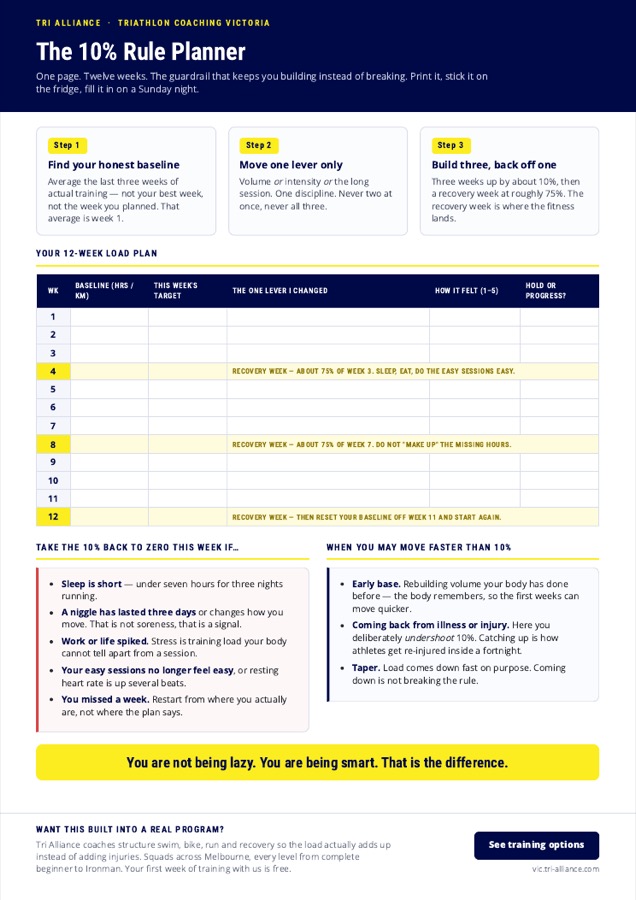
You are not being lazy. You are being smart. That is the difference.
If you want a plan that builds the 10% rule into your training properly across swim, bike, run and recovery, Tri Alliance coaches can structure it through triathlon training plans or squad coaching.
Training with purpose
Get the 10% rule built into your training
Tri Alliance coaches structure swim, bike, run and recovery so the load actually adds up instead of adding injuries. Squads right across Melbourne, every level from complete beginner to Ironman, and your first week of training with us is free.
Discover more from Tri Alliance Triathlon Community
Subscribe to get the latest posts sent to your email.