
Mental Toughness Is a Trainable Skill, Not a Personality Trait
When Craig Alexander won Kona four times, or when Alistair Brownlee hauled himself back from multiple near-collapses, the narrative defaulted to “mental toughness.” The implication was that they possessed something others lacked — an innate psychological hardness. This framing is both incorrect and unhelpful. Mental toughness in triathlon is a set of learnable skills: attentional control, self-talk regulation, goal refocusing, and arousal management. You train your swim stroke. You train your threshold. You can train these too.
What separates elite triathletes’ psychological approach from most age groupers’ isn’t mysterious. It’s systematic, deliberate practice applied to mental skills with the same rigour they apply to physical training. This article breaks down what those skills are, how elites develop them, and how a Melbourne-based age grouper can apply the same methods.
The Four Pillars of Elite Triathlon Mental Toughness
1. Attentional Control Under Fatigue
In the final 10 km of an Ironman run, at 35°C on the Queen K or across the St Kilda foreshore, the brain’s default mode under extreme fatigue is to fixate on discomfort and extrapolate it forward (“I can’t maintain this pace for another 40 minutes”). Elite athletes consistently report the ability to redirect attention — to present-moment process cues (cadence, form, breathing) rather than outcome projections.
This is not willpower. It is a trained attentional habit. Neuroimaging research on elite athletes shows reduced activity in the default mode network (the brain’s rumination circuit) during high-load performance compared to novices. This reduction develops through deliberate practice of attentional redirection during training — specifically during hard sessions when the temptation to disengage or slow is greatest.
The drill: During your next threshold run, when fatigue cues arise, implement a 3-second redirect. Notice the thought (“this hurts, I should slow down”), label it (“that’s a sensation, not a command”), then redirect to a specific process cue (foot strike timing, arm angle, breath count). Practice this in training 20–30 times per session and the neural pathway strengthens.
2. Self-Talk Regulation
Research by Antonis Hatzigeorgiadis (University of Thessaly) across multiple endurance sports showed that instructional self-talk (“quick, light”) during performance outperforms motivational self-talk (“come on, you can do it”) during skill-demanding phases, while motivational self-talk shows advantages during endurance-dominant phases. Most athletes use self-talk haphazardly. Elites script it.
Erin Densham (2012 Olympic silver medallist, coached in Australia) has described using specific mantras anchored to different race phases — a technical cue for the swim entry, a power cue for the bike climb, a form cue for the run deterioration phase. These aren’t inspirational posters. They’re specific, functional, practiced under simulated fatigue in training.
Implementation: Write three mantras — one technical, one effort-anchor, one permission (“I trained for this”) — and practice vocalising them during hard intervals in training, especially in the final third of a hard session when they’re hardest to access.
3. Pre-Competition Routines and Arousal Management
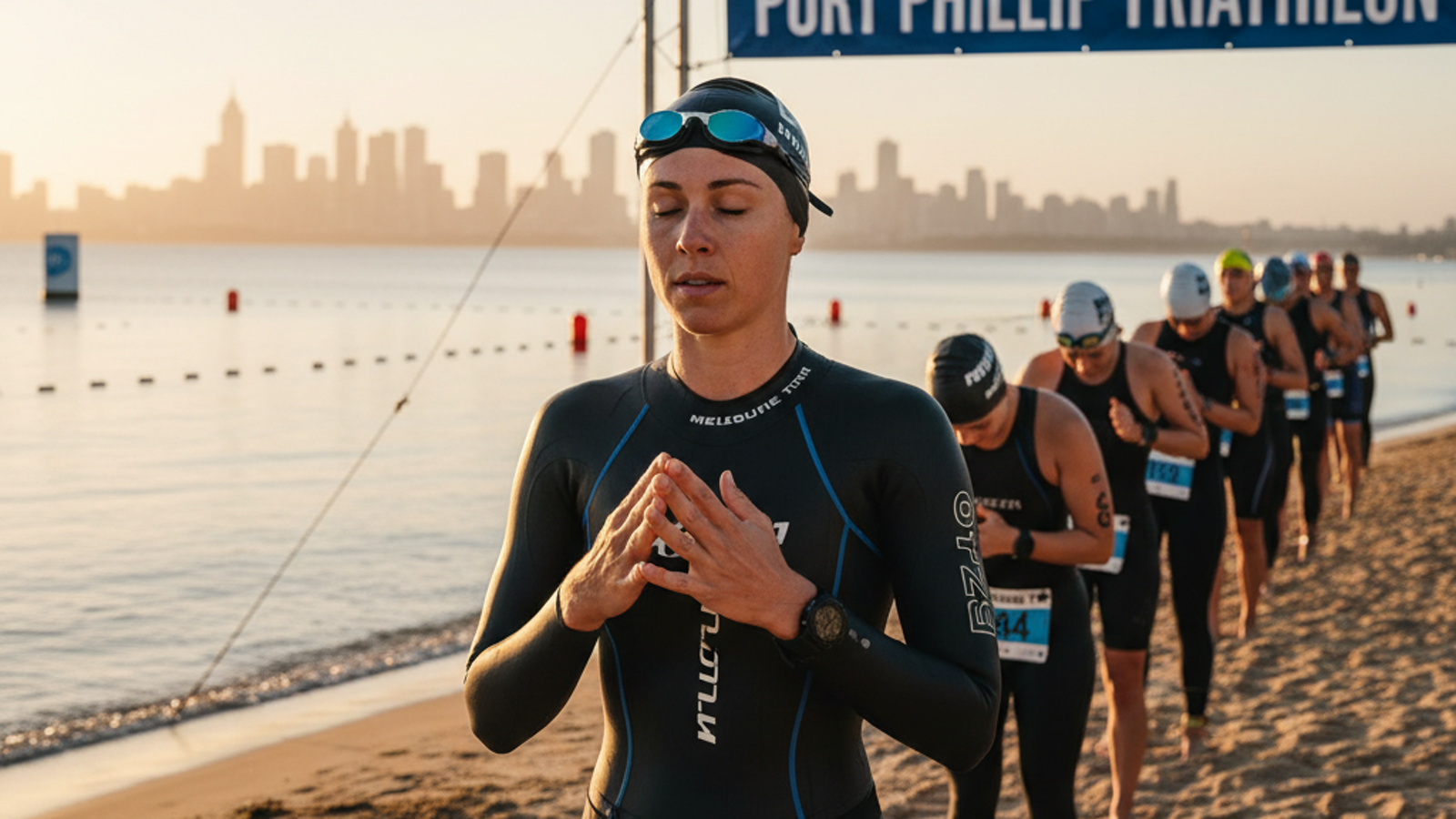
Elite triathletes, unlike many age groupers, arrive at the transition area at the same time with the same sequence each race. This isn’t OCD. It is deliberate arousal regulation via routine — using predictable stimulus sequences to manage pre-race anxiety and maintain optimal activation level.
The inverted U model (Yerkes-Dodson) describes performance as optimal at a moderate arousal level, with degraded performance at both very low (under-aroused, flat) and very high (over-aroused, panicked) states. Many age groupers arrive at Albert Park Lake for an open water swim start chronically over-aroused — heart rate elevated, attention narrowed, motor patterns disrupted.
| Arousal state | Signs | Performance effect | Management technique |
|---|---|---|---|
| Under-aroused | Flat, unmotivated, slow warm-up HR | Below-threshold effort, poor decisions | Upbeat music, short activation sprints, social engagement |
| Optimal | Alert, focused, mild butterflies | Best performance window | Maintain with routine, familiar environment cues |
| Over-aroused | Racing HR, narrow attention, catastrophising | Excessive early pace, technical breakdown | Box breathing (4-4-4-4), progressive muscle relaxation, reframing |
4. Goal Refocusing After Adversity
Every triathlon beyond sprint distance will contain at least one moment where the race doesn’t go to plan. A flat tyre at Ironman 70.3 Geelong. A cramp at the 3 km swim mark. Missing a nutrition window. Elite athletes maintain performance not by avoiding these events, but by having a pre-practiced response to them — what sports psychologists call a “reset routine.”
The reset routine typically involves three components: acknowledge (name the setback without catastrophising), release (a physical cue — a breath, a hand gesture, a reset word), and refocus (immediately shift to the next actionable process goal). Athletes who practice this in training handle race-day adversity faster because the neural pathway for the response is already well-grooved.
Lessons from Specific Elite Athletes
Terenzo Bozzone: The Process Over Outcome Anchor
New Zealand’s Terenzo Bozzone, one of the most consistent long-course performers of the past decade, has spoken extensively about his shift from outcome-focused (“I need to win”) to process-focused racing. In the 2010s, he began structuring his race execution entirely around power targets and run cadence rather than position relative to competitors. The result was more consistent execution and reduced performance anxiety around things outside his control — specifically, what other athletes were doing.
Nicola Spirig: Deliberate Discomfort Training
Olympic gold and silver medallist Nicola Spirig (Switzerland) describes systematic exposure to discomfort in training as central to her preparation — not just physical discomfort, but deliberately training in conditions she dislikes. Cold morning swims. Sessions started when fatigued. Training through minor illness discomfort (not injury). Each deliberate discomfort exposure builds what she describes as “the knowledge that I have been here before and survived.” This is essentially habituation of the threat-response network.
Jan Frodeno: Visualisation With Specific Failure Scenarios
Three-time Ironman World Champion Jan Frodeno has described his pre-race visualisation as including not just successful execution but specific failure scenarios and their responses. He mentally rehearses a flat tyre at kilometre 100, a swim start collision, cramping on Ali’i Drive. This is the opposite of positive thinking — it is systematic mental rehearsal of adversity response, which research shows reduces performance disruption when those events actually occur.
Building Mental Toughness Into Your Training Week
You don’t need a sports psychologist to start. Three practical integrations for Melbourne-based athletes:
- Weekly “discomfort sessions”: Once per week, build a training session specifically designed to be psychologically difficult — cold open water at Elwood Beach in May, a threshold set when already fatigued, a long bike in rain on Beach Road. These aren’t for physical adaptation. They’re for mental skill practice.
- Self-talk journaling: Immediately after hard sessions, note what your internal dialogue was during the hardest 5 minutes. Pattern recognition over 4–6 weeks reveals your default negative thought sequences — which you can then counter with pre-scripted responses.
- Process goals only on race day: No outcome goals (placing, time) in your active race-day mental script. Only process metrics: watts, cadence, stride rate, nutrition timing. Outcome awareness will occur naturally without explicit attention.
The Role of Coaching in Mental Toughness Development
The psychological dimension of triathlon performance is increasingly integrated into evidence-based coaching programs. Tri Alliance coaching incorporates session design that deliberately targets mental skill development — building in appropriate discomfort exposure, teaching attentional redirection during group sessions, and providing structured feedback on psychological patterns that affect performance.
Athletes in the Tri Alliance squads in Melbourne benefit from training with peers at similar and higher performance levels — a powerful context for developing competition-specific mental skills in a low-stakes environment before race day.
FAQ: Triathlon Mental Toughness
Can mental toughness be trained in triathlon?
Yes. Mental toughness is not a fixed trait — it is a collection of specific psychological skills (attentional control, self-talk regulation, arousal management, adversity response) that improve with deliberate practice. Research in sport psychology consistently shows these skills respond to training methods analogous to physical skill development: clear skill identification, structured practice under appropriate challenge, and feedback-based refinement. An athlete who has never practiced attentional redirection under fatigue will not reliably execute it on race day.
What mental strategies do elite triathletes use?
Elite triathletes consistently report using pre-competition routines (arousal regulation), scripted self-talk anchored to race phases, process-focused goal structures (watts, cadence, nutrition timing rather than position or time), visualisation including adversity scenarios, and reset routines for in-race setbacks. These strategies are specific, practiced under simulated fatigue in training, and adapted over multiple race seasons rather than adopted from generic sports psychology books.
How do you build mental toughness for Ironman racing?
The most effective approach is systematic exposure to discomfort in training combined with deliberate skill practice during hard efforts. Specifically: include weekly sessions designed to be psychologically difficult, practice attentional redirection (present-moment cues over outcome thoughts) during every threshold session, develop a race-day self-talk script and rehearse it under fatigue, and build a reset routine for setbacks that you practice in training before race day. Mental preparation for a 10–12 hour event requires months of groundwork, not a pre-race visualisation the night before.
What is the psychology behind triathlon performance?
Performance psychology in triathlon draws on attentional control theory (Nideffer), the biopsychosocial model of effort and pacing (Marcora), and self-determination theory (Deci and Ryan). The core finding across these frameworks: subjective perception of effort, not peripheral physiological signals, is the primary determinant of pacing decisions in endurance sport. Athletes who can manage the psychological experience of effort — through attentional control, self-talk, and arousal regulation — can access more of their physiological capacity than those who cannot.
How do elite triathletes handle bad races?
Elite athletes distinguish between controllable and uncontrollable variables, and focus post-race analysis exclusively on the former. After a bad race, systematic debrief covers: what in my preparation was within my control and fell short? What was external? What specific changes address the controllable failures? This process-focused analysis prevents the global negative attribution (“I’m not good enough”) that erodes confidence, and maintains the specific-actionable attribution (“my hydration strategy failed on the bike”) that drives improvement.
Develop your mental race skills alongside your physical conditioning with Tri Alliance. Explore coaching programs or join a Melbourne squad.
Discover more from Tri Alliance Triathlon Community
Subscribe to get the latest posts sent to your email.