The Cycling Accessories That Actually Matter for Triathletes
Every bike shop will tell you everything is essential. It isn’t. For triathletes training and racing in Melbourne and across Australia, the accessories below are the ones that affect performance, safety, and comfort on real rides — not just in theory.
Helmet: Non-Negotiable, But the Right Type Matters
Australian law requires an approved helmet on every ride. For triathletes, the choice comes down to road helmet vs. aero helmet.
A standard road helmet (Giro Aether MIPS, ~AU$400; Kask Protone, ~AU$380) is cooler and better ventilated for training rides in Melbourne’s summer heat. An aero helmet (Lazer Bullet 2.0, ~AU$550; Specialized TT5, ~AU$700) saves 30–60 seconds per hour in a race tuck at 40 km/h — significant over a 180 km Ironman bike leg.
For Olympic or 70.3 racing, a vented aero helmet like the Giro Vanquish (~AU$350) splits the difference. Don’t wear an aero helmet in training — overheating kills more training sessions than poor aerodynamics.
Cycling Computer: Data on the Bars
Running your GPS watch as your cycling computer works but isn’t ideal — screen size and navigation are compromised. A dedicated cycling computer with a handlebar mount gives you more data at a glance and better battery management.
| Computer | Price (AUD) | Key Feature | Best For |
|---|---|---|---|
| Garmin Edge 540 | $579 | ClimbPro, navigation, power | Hilly routes, training |
| Wahoo ELEMNT Bolt | $449 | Auto-upload, clean interface | Zwift users, minimalists |
| Garmin Edge 1040 Solar | $999 | Solar charging, 45-hr battery | Ironman, ultra-distance |
| Bryton Rider 750 | $299 | Mapping, power support | Budget-conscious riders |
Triathlon-Specific Bike Setup
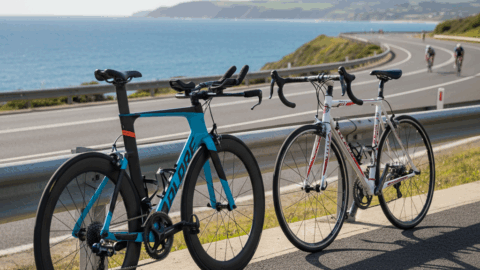
Standard road bikes can be adapted for triathlon with a few key accessories:
Aero Bars
Clip-on aero bars (Profile Design, ~AU$120–250) allow a time-trial position on a road bike. This isn’t as fast as a dedicated tri bike but can save 2–4 minutes per hour compared to riding on the hoods. Spend at least one session getting your position dialled before using them in a race.
Hydration Systems
For races over 90 minutes, you need an on-bike hydration system. A between-the-bars system (Profile Design Aero HC, ~AU$120) keeps fluid accessible without sitting up. Behind-seat cages work for bottle storage but require reaching back — practice this in training so you don’t lose a bottle at speed.
Tyre Setup: Tubeless or Clincher?
Tubeless tyres (Continental GP5000S TR, ~AU$110 each) reduce rolling resistance and allow you to run 2–5 psi lower, improving comfort and grip. The setup is more complex but punctures can often be sealed with sealant rather than causing a DNF. For Melbourne’s roads — particularly training routes through the Dandenong Ranges — the puncture resistance matters.
If you’re not ready to go tubeless, a quality clincher tyre (Continental GP5000, ~AU$85) with a latex inner tube (AU$18) is the next best option.
Safety Gear for Melbourne Roads
Melbourne cycling infrastructure has improved significantly, but group rides on Nepean Highway, Beach Road, and through the Yarra Valley still require active safety measures:
- Rear light: A Garmin Varia radar tail light (AU$349) detects approaching cars and alerts your head unit — genuinely useful on Beach Road during morning squad rides
- Front light: 400+ lumen minimum for daylight visibility (Lezyne Macro Drive, ~AU$90); 1000+ for any pre-dawn or post-dusk riding
- ID/emergency card: Medical ID wristband or Road ID (AU$40) for solo training sessions
Shoes and Pedals: The Efficiency Upgrade
Cycling in running shoes and flat pedals wastes power. Clipless pedal systems transfer force through the entire pedal stroke. For triathlon, Look Keo pedals are the most common — easy entry and exit, single-sided engagement. Shimano SPD-SL (road) pedals are equally valid.
Triathlon-specific cycling shoes (Shimano TR9, ~AU$350; Bont Riot+, ~AU$270) have a single velcro strap for fast transitions. Standard road shoes work fine if you’re not racing.
If you train with Tri Alliance squad sessions, most coaches recommend establishing a solid bike fit before investing in high-end shoes — position changes can affect cleat placement significantly.
Frequently Asked Questions
Do I need a cycling computer if I already have a GPS watch?
Not strictly, but a dedicated head unit with a larger screen makes it easier to read power, speed, and navigation mid-ride. If you train with power, the Wahoo ELEMNT Bolt is worth the investment.
Are aero bars legal in all triathlon races?
Yes in most triathlons — aero bars are standard equipment. They’re prohibited in some draft-legal events and not permitted on standard road bikes in bunch rides due to safety concerns.
What tyres should I use for Beach Road training rides?
Continental GP5000 (clincher) or GP5000S TR (tubeless). Both offer good puncture resistance for Melbourne’s glass-strewn cycling paths and reliable grip in wet conditions.
How much should I spend on a first cycling helmet?
Spend AU$150–$300 minimum for a helmet with MIPS protection. WaveCel and MIPS technology meaningfully reduce rotational force in impacts. Don’t buy a AU$60 helmet for a sport with significant fall risk.
Is the Garmin Varia radar worth buying?
Yes for regular solo training on open roads. The radar alert gives you 2–3 seconds of warning before a car overtakes — enough to move further left or improve your line. Essential for early-morning Beach Road sessions.
Discover more from Tri Alliance Triathlon Community
Subscribe to get the latest posts sent to your email.