
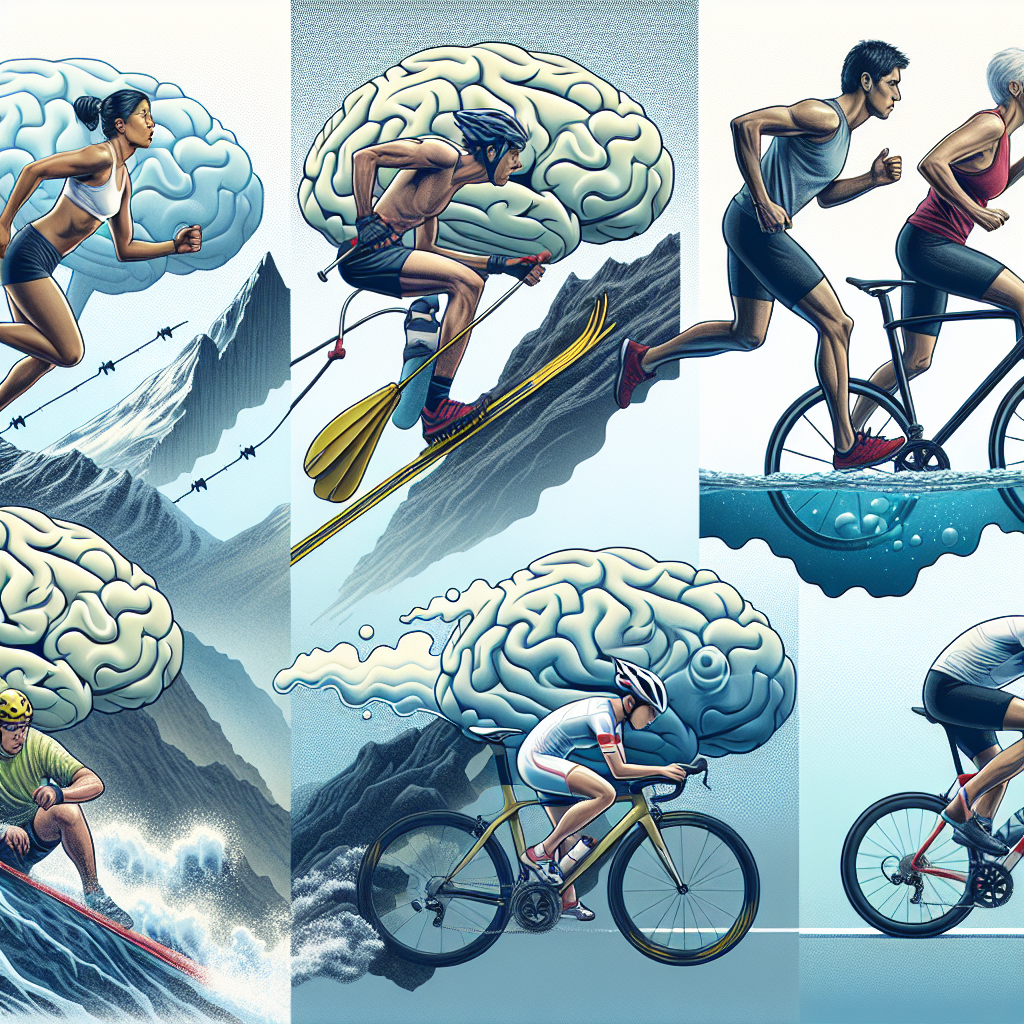
Overcoming Mental Barriers in Endurance Sports: A Practical Guide for Triathletes
At kilometre 28 of a half-ironman run, something shifts. The legs are heavy, the pace has dropped, and a voice in your head starts negotiating — “you could walk to the next aid station,” “you’ve done enough,” “this just isn’t your day.” This is not a fitness problem. This is a mental barrier, and every endurance athlete encounters them. The question is whether you have the tools to work through them.
For Melbourne triathletes training on The Tan, along Beach Road, or logging open water sessions in Port Phillip Bay, developing mental resilience is as trainable as VO2 max. This guide outlines practical, evidence-based strategies to identify, confront, and overcome the psychological obstacles that limit performance.
Understanding What Mental Barriers Actually Are
Mental barriers in endurance sports are not character flaws or signs of insufficient commitment. They are predictable neurological responses to sustained physical stress. When the body approaches its physiological limits, the brain generates signals designed to protect it — reduced motivation, exaggerated pain perception, catastrophic thinking, and the overwhelming urge to slow down or stop.
Research from sports neuroscience suggests that the “central governor” model of fatigue is partly psychological: athletes are rarely actually at their physical limit when they feel they are. The perception of effort is modifiable. Training the brain to accurately interpret (rather than catastrophise) these signals directly improves performance.
The Four Most Common Mental Barriers in Triathlon
1. Self-Doubt Before the Start Gun
Pre-race self-doubt typically centres on comparison (“everyone else looks fitter”), negative self-talk (“I haven’t trained enough”), and outcome anxiety (“what if I don’t make the cut-off”). These patterns are common and respond well to structured intervention.
2. The Dark Patch in the Middle of a Race
Every long-course triathlete hits a period — usually on the run — where continuation feels genuinely optional. This “dark patch” is partly physiological (glycogen depletion, heat stress) and partly psychological. It is always temporary. Knowing this in advance is itself a useful tool.
3. Training Monotony and Loss of Motivation
Long training blocks leading to events like Ironman Melbourne or Busselton produce mental fatigue that mimics demotivation. The athlete is not uninterested in the goal — they are mentally fatigued by the process. This requires different interventions than addressing motivational issues.
4. Post-Bad-Race Identity Crisis
Many athletes over-identify with their race results. A bad race becomes evidence of being a bad athlete or person. This conflation of performance with identity is a significant mental barrier to consistent improvement.
Evidence-Based Strategies to Break Through Mental Barriers
Positive Self-Talk: Script It Before You Need It
Research consistently shows that instructional self-talk (“quick feet”, “stay smooth”) and motivational self-talk (“I’ve trained for this”) improve performance under fatigue. The key is preparation: develop your specific cue words and phrases in training, not during a race. When you are hurting on the Beach Road ride and need to hold power, a pre-prepared phrase cuts through the noise more effectively than improvised thinking.
Develop a personal cue vocabulary of 3-5 phrases. Test them in hard training sessions. Use the ones that actually change your state.
Segmentation: Breaking the Race into Manageable Pieces
Rather than confronting the full remaining distance during a hard patch, effective athletes use segmentation — focusing only on reaching the next landmark. On a run along The Tan, that might mean “just get to the river bend.” On a long training ride from Albert Park to Frankston, it might mean “just finish this 10km block.” Each completed segment builds momentum and restores agency.
Reframing Discomfort as Progress
Discomfort in endurance sport is not the enemy — it is confirmation that the body is being challenged and adapting. Athletes who interpret the burn in their legs as “this means I’m getting stronger” perform measurably better than those who interpret the same sensation as “this means I’m failing.” This reframe needs to be practised in training until it becomes automatic.
The 30-Second Rule for Negative Thought Spirals
When negative thoughts arise during a race, experienced athletes use a deliberate acknowledge-and-release technique: name the thought (“there’s the quitting voice”), give it 30 seconds, then replace it with your pre-set process cue. Trying to suppress negative thoughts tends to amplify them. Acknowledging them neutrally removes their power.
Building Mental Resilience in Training
Mental barriers cannot be overcome on race day if they have never been practised in training. Deliberately including hard mental moments in your training builds the resilience you’ll need when it matters. Practical approaches include:
| Training Scenario | Mental Skill Practised | How to Apply |
|---|---|---|
| Final 2km of a long run on The Tan | Holding pace under fatigue, positive self-talk | Commit to not slowing — use cue words when it gets hard |
| Open water swim in Port Phillip Bay (choppy conditions) | Composure under uncertainty, rhythmic breathing | Practise staying with the discomfort for 2 minutes before seeking calmer water |
| Last 30 minutes of a 3-hour ride on Beach Road | Segmentation, reframing fatigue | Break into 5-minute blocks, use motivational self-talk at each marker |
| Brick sessions (bike-run) | Rapid mental transition, dark-patch tolerance | Practise not negotiating with the urge to slow in the first 2km of the run |
The Role of Mindfulness in Managing Mental Barriers
Mindfulness practice — specifically the ability to observe a thought without immediately acting on it — is the foundational skill that underpins all other mental barrier strategies. An athlete who can notice “there’s a quitting thought” without fusing with it has dramatically more control over their racing than one who cannot.
Even 10 minutes of daily mindfulness practice over 8 weeks measurably improves attentional control under stress. This improvement transfers directly to the ability to hold focus and composure in a race. For a structured approach to mindfulness and mental performance as part of your triathlon program, visit vic.tri-alliance.com/coaching.
Frequently Asked Questions
How do I know if I’m hitting a mental barrier or a real physiological limit?
True physiological limits involve inability to continue — involuntary muscle failure, loss of coordination, or medical symptoms. Mental barriers feel like a very strong preference not to continue. If you can still physically move at your current pace, the barrier is at least partly mental. Breathing, hydration, and nutrition status can help clarify whether something physical is contributing.
Does self-talk actually work or is it just positive thinking?
Self-talk is well-supported in sports psychology research. A 2011 meta-analysis across 32 studies showed significant performance benefits for both motivational and instructional self-talk. The key factors are specificity (vague affirmations are less effective than precise cues), practice (it needs to be trained), and authenticity (the statements need to feel credible to the athlete).
I train with a group — does social pressure help or hurt with mental barriers?
Group training can help by creating accountability and normalising the experience of hard training. It can hurt if it leads to pacing decisions driven by ego rather than strategy. The mental skill to distinguish “this is hard in a productive way” from “I’m going too hard because I don’t want to be dropped” is worth developing explicitly.
How do I recover mentally after a DNF or a very bad race?
Debrief the race systematically — what was within your control and what wasn’t? Separate performance from identity: “I had a bad race” is different from “I am a bad athlete.” Reconnect with your original motivation for doing the sport. Then set a specific next goal and get back into training. The return to structured preparation is one of the fastest routes back to positive mental state.
Are there coaches in Melbourne who specifically address mental performance in triathlon?
Tri Alliance Victoria integrate mental skills coaching into their structured triathlon programs, with coaches experienced in working through the psychological demands of long-course racing. Explore options at vic.tri-alliance.com/training-programs.
Discover more from Tri Alliance Triathlon Community
Subscribe to get the latest posts sent to your email.