Stretching Routines for Triathletes: A Complete Protocol for All Three Disciplines
Triathletes place demands on the body that single-sport athletes do not. Swimming requires thoracic rotation and shoulder mobility. Cycling creates hip flexor tightness and thoracic kyphosis. Running loads the posterior chain — hamstrings, calves, glutes. An effective stretching routine addresses all three disciplines’ movement patterns and manages the cumulative stiffness that builds across a training week. This guide provides specific named stretches, hold times, sets and timing for triathlete-specific recovery.
Dynamic Stretching: Pre-Workout Protocol (8–10 minutes)
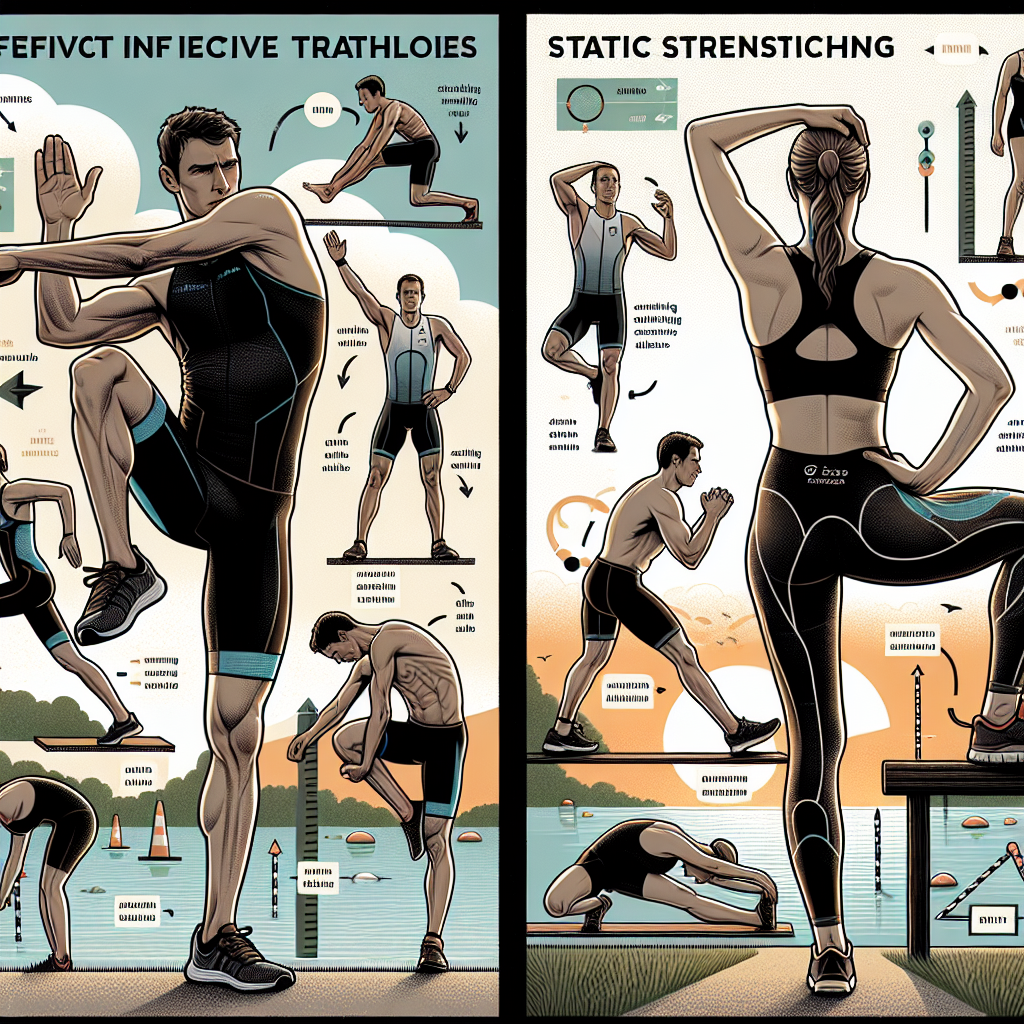
Dynamic stretching — controlled movement through range of motion — is the correct warm-up approach before triathlon training. Static holds before exercise reduce force production and neural activation. Dynamic work raises tissue temperature, activates motor patterns and prepares joints for load.
Pre-Swim Dynamic Stretches
| Stretch | Reps / Duration | Target |
|---|---|---|
| Arm circles (forward and backward) | 15 each direction | Shoulder joint, rotator cuff |
| Thoracic rotation (seated or standing) | 10 each side | T-spine, obliques |
| Shoulder cross-body swings | 15 reps | Posterior shoulder, rear delt |
| Neck half-circles (side to side, not full rotation) | 8 each direction | Cervical spine, neck extensors |
| Hip circles | 10 each direction | Hip joint, hip flexors |
Pre-Bike Dynamic Stretches
| Stretch | Reps / Duration | Target |
|---|---|---|
| Leg swings (front-to-back) | 15 each leg | Hip flexors, hamstrings |
| Lateral leg swings | 15 each leg | Adductors, abductors, hip external rotators |
| Walking lunges with torso rotation | 10 each leg | Hip flexors, thoracic spine |
| Heel-to-toe ankle rolls | 10 each direction | Ankle mobility, calves |
| Quad stretch walk (pull heel to glute) | 10 each side | Quadriceps, hip flexors |
Pre-Run Dynamic Stretches
| Stretch | Reps / Duration | Target |
|---|---|---|
| High knees (20m) | 2 x 20m | Hip flexors, core activation |
| Butt kicks (20m) | 2 x 20m | Quadriceps, knee drive |
| A-skips | 2 x 20m | Hip drive, calf activation |
| Lateral shuffle | 2 x 20m | Adductors, glute medius |
| Calf raises (slow and fast) | 15 slow + 15 fast | Soleus, gastrocnemius |
Static Stretching: Post-Workout Protocol (15–20 minutes)
Static stretching is most effective post-workout when muscles are warm. Hold each stretch 30–45 seconds minimum for genuine flexibility improvement — brief holds under 20 seconds have limited carryover effect. Perform 2 sets of each stretch.
Lower Body Static Stretches
| Stretch Name | Hold Time | Sets | Target Muscle | Technique Note |
|---|---|---|---|---|
| Seated hamstring stretch | 45 sec each side | 2 | Hamstrings, posterior chain | Sit with leg extended, hinge at hip (not rounded back), reach toward foot |
| Standing quad stretch | 30 sec each side | 2 | Quadriceps | Pull heel to glute, keep knees together, maintain upright posture |
| Pigeon pose (hip flexor/glute) | 60 sec each side | 2 | Piriformis, glutes, hip external rotators | Front shin roughly parallel to torso; use a folded towel under hip if needed |
| Hip flexor lunge stretch | 45 sec each side | 2 | Psoas, iliacus | Back knee on ground, drive hips forward; add arm raise and side lean for TFL |
| Calf stretch (straight knee) | 45 sec each side | 2 | Gastrocnemius | Foot flat against wall or step, lean forward; heel stays grounded |
| Calf stretch (bent knee) | 45 sec each side | 2 | Soleus | Same position but bend the back knee to isolate the deeper calf muscle |
| IT Band / side stretch | 30 sec each side | 2 | IT band, TFL | Cross one foot behind the other, lean away from the back leg; use a wall for balance |
| Adductor groin stretch | 45 sec | 2 | Adductors, inner thigh | Seated, soles of feet together, gently press knees toward floor |
Upper Body and Spine Static Stretches
| Stretch Name | Hold Time | Sets | Target Muscle | Technique Note |
|---|---|---|---|---|
| Doorway chest stretch | 30 sec each side | 2 | Pectorals, anterior shoulder | Arm at 90°, elbow on doorframe, rotate body away; feel stretch across chest |
| Cross-body shoulder stretch | 30 sec each side | 2 | Posterior shoulder, rear delt | Bring one arm across chest, use opposite hand to press gently above elbow |
| Lat stretch (doorframe or pole) | 30 sec each side | 2 | Latissimus dorsi | Grip at shoulder height, drop hips back and down; feel stretch under armpit/side |
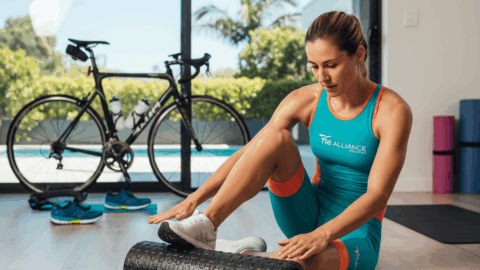
| Thoracic extension over foam roller | 60–90 sec | 2 | Thoracic spine, chest | Roller perpendicular to spine at mid-back; support head, arms out wide; move 2–3 vertebrae at a time |
| Child’s pose | 60 sec | 2 | Thoracic spine, lats, hip flexors | Arms extended overhead on floor; walk hands to each side for lat variation |
| Neck side stretch | 30 sec each side | 2 | Levator scapulae, upper traps | Ear to shoulder, use hand for gentle added pressure; do not rotate head |
Incorporating Yoga into Triathlete Recovery
A 30–60 minute yoga session once or twice per week on active recovery days provides mobility benefits that routine stretching cannot fully replicate. Focus on yin yoga or restorative yoga styles, which use sustained passive holds (2–5 minutes) targeting deep connective tissue and the hip complex.
Key poses for triathletes:
- Downward-facing dog — simultaneous hamstring, calf and thoracic stretch; essential for run recovery
- Cobra / Sphinx — counteracts the aero position’s lumbar and thoracic flexion
- Warrior I and II — hip flexor opening with balance challenge
- Reclining pigeon (Supta Kapotasana) — deep glute and external hip rotator release
- Legs up the wall (Viparita Karani) — passive venous return aid, reduces leg heaviness post long session
Melbourne has strong yoga communities with studios in Fitzroy, South Yarra, St Kilda and the CBD offering early morning and evening classes compatible with triathlon training schedules. Many studios offer open-level classes suitable for training recovery.
Stretching Routine by Session Type
| After Session Type | Priority Stretches | Duration |
|---|---|---|
| Long run | Calves (both), hamstrings, hip flexors, IT band, piriformis | 15–20 min |
| Long ride | Hip flexors, quad, thoracic extension, neck, lower back | 15–20 min |
| Swim squad | Thoracic extension, lats, cross-body shoulder, neck | 10–15 min |
| Brick (bike + run) | Full lower body + thoracic — all groups | 20–25 min |
| Strength / S&C session | Area-specific — match to muscles trained | 10–15 min |
Tri Alliance Stretching Resources
The Tri Alliance Victoria training programs include post-session cool-down and stretching guidance specific to each session type. Group training sessions with Tri Alliance coaches include cool-down stretching so athletes develop correct technique and habits. For athletes managing flexibility limitations or injury history, individual physiotherapy assessment can identify specific restriction patterns to prioritise.
FAQ: Stretching for Triathletes
Should I stretch before or after training?
Both — but different types. Dynamic stretching (movement-based) before sessions prepares muscles without reducing force production. Static holds (30–45 seconds) belong after sessions when muscles are warm, to drive genuine flexibility improvements. Never perform long static holds on cold muscles immediately before high-intensity work.
How long do I need to hold a stretch to improve flexibility?
Research indicates 30–45 seconds per side, performed consistently, produces measurable flexibility gains over 4–6 weeks. Holds under 15 seconds provide short-term range increase but minimal lasting change. Two sets of 45 seconds outperforms four sets of 20 seconds for flexibility outcomes.
My hamstrings are always tight — what’s the best stretch?
The seated hamstring stretch performed with a hip hinge (not a rounded back) is most effective. For triathletes specifically, also address neural tension — the sciatic nerve runs through the hamstring and is often a contributor to perceived “tightness.” A neural flossing exercise (straight leg raise with ankle pump) performed before the hamstring stretch often improves range immediately.
How often should triathletes stretch?
Post every training session (10–20 minutes) plus a dedicated full mobility session once per week (30–60 minutes). During heavy training weeks, consider two dedicated sessions. The cumulative tissue stiffness of swim/bike/run combined is greater than single-sport athletes and requires proportionally greater mobility work to manage.
Is PNF stretching worth doing?
Yes — proprioceptive neuromuscular facilitation (PNF) produces greater flexibility gains than static stretching alone. The contract-relax method (isometrically contract the target muscle against resistance for 5–6 seconds, then relax into a deeper stretch) works well with a training partner or can be self-applied on some muscle groups. Most effective for hamstrings, hip flexors and shoulder internal rotation. A physiotherapist or Tri Alliance coach can demonstrate correct technique.
Discover more from Tri Alliance Triathlon Community
Subscribe to get the latest posts sent to your email.