Why Triathletes Need Targeted Physical Therapy Work
A triathlete’s body moves through three biomechanically distinct disciplines every training week — and the cumulative repetitive stress creates specific injury patterns that general gym programs don’t address. Swimming 10km, cycling 200km, and running 40km weekly exposes the shoulders, hips, knees, and ankles to millions of repetition cycles. Tri Alliance Victoria coaches work with Melbourne sports physiotherapists to build targeted physical therapy exercises into athlete programs — particularly during build and peak phases when injury risk peaks.
This guide provides the essential PT exercises, sets, reps, and timing recommendations for triathlete injury prevention and performance enhancement.
Core Stability: The Foundation of All Three Disciplines
Core weakness is the root cause of most triathlete overuse injuries — from swimmer’s shoulder to runner’s knee. A stable core maintains efficient power transfer and protects the spine through fatigue.
Essential Core Exercises for Triathletes
| Exercise | Sets × Reps/Duration | Triathlon Application | Progression |
|---|---|---|---|
| Plank (forearm) | 3 × 45–60 seconds | Swim body position, run posture | Add leg lift, progress to RKC plank |
| Side plank | 3 × 30–45 seconds each side | Lateral stability, run cross-body mechanics | Add hip dip, progress to star side plank |
| Dead bug | 3 × 10 reps each side | Anti-rotation stability, breathing under load | Add resistance band, progress to dynamic version |
| Pallof press | 3 × 12 each side | Anti-rotation during cycling power phase | Increase band resistance, add kneeling variation |
| Glute bridge | 3 × 15 | Hip extension power (run and bike) | Single-leg bridge, add barbell load |
Programming: Perform 3–4 core sessions per week, 15–20 minutes each. Ideal placement: immediately before swim, bike, or run sessions as a warm-up activation sequence.
Lower Body Strength: Power for Cycling and Running
Key Lower Body Exercises
Squats — 3 sets × 12–15 reps
Targets quadriceps, hamstrings, and glutes — the primary engine of cycling power and running propulsion. Technique cues: feet shoulder-width, knees track over second toe, descend until thighs parallel to floor, drive through heel. For triathletes new to squatting, begin with goblet squat (hold a dumbbell at chest) to reinforce lumbar neutral. Progress to barbell back squat at 8–10 weeks.
Single-Leg Romanian Deadlift — 3 sets × 10 reps each leg
Addresses the unilateral strength deficits common in triathletes (often one leg stronger from cycling asymmetry). Targets hamstrings, glutes, and proprioception — critical for run economy and injury prevention. Start bodyweight, progress to dumbbell in opposite hand, then barbell.
Step-ups — 3 sets × 12 each leg
Replicates the single-leg power of cycling and running. Use a box height of 40–50cm. Drives knee over toe, maintains upright torso. Add a weighted vest at 4–6 weeks.
Calf Raises — 3 sets × 20 reps (slow eccentric)
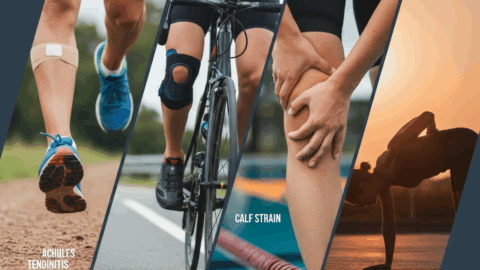
Calf injuries (Achilles tendinopathy, soleus strains) are among the most common triathlete running injuries. Eccentric calf raises (3-second lowering phase) have the strongest evidence base for prevention and rehabilitation. Perform off a step edge, progress to single-leg when 20 double-leg reps are easy.
Shoulder Stability: Protecting the Swim Shoulder
Swimmer’s shoulder (subacromial impingement) affects up to 47% of competitive swimmers. The following exercises target the rotator cuff and scapular stabilisers — critical for triathlon swim training volumes of 15–20km per week.
Rotator Cuff Protocol — 3 sessions per week
- External rotation with resistance band: 3 × 15 reps, elbow at 90°, band level with elbow. Slow and controlled — 2 seconds out, 2 seconds return. The primary prevention exercise for swimmer’s shoulder.
- Wall slides: 3 × 10 reps. Stand facing wall, forearms on wall, slide arms upward maintaining contact. Activates lower trapezius and serratus anterior — critical for scapular upward rotation during freestyle stroke.
- Band pull-apart: 3 × 15 reps with resistance band at shoulder height. Retracts scapulae and activates mid-trapezius — corrects the forward-rounded posture caused by cycling.
- Y-T-W raises: 2 × 10 reps each position, light weight (1–2kg). Comprehensive scapular stabiliser activation sequence; perform prone on a bench.
Flexibility and Mobility: Maintaining Range of Motion
Hip Flexor and Thoracic Spine (Critical for Cyclists)
Cyclists spend 3–6 hours per session in hip flexion and thoracic flexion, creating tightness that directly impairs running mechanics. Address daily:
- Half-kneeling hip flexor stretch: 3 × 60-second hold each side. Tuck posterior pelvis to maximally stretch the psoas. Perform immediately after every ride.
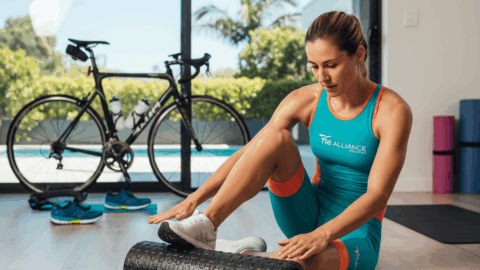
- Thoracic spine foam roll: 2 minutes, 10 extensions at each vertebral segment from T4–T12. Restores thoracic extension mobility lost in the cycling position.
- World’s greatest stretch: 5 reps each side as part of warm-up. Combines hip flexor, hip external rotation, thoracic rotation, and hamstring — the single best all-in-one mobility exercise for triathletes.
Hamstring and Calf Mobility (Critical for Runners)
- Static hamstring stretch: Post-run only — 3 × 60-second hold each leg. Dynamic stretching pre-run, static post-run.
- Ankle circles and dorsiflexion mobilisation: 2 × 10 circles each direction; 3 × 10 ankle dorsiflexion against wall. Restricted ankle dorsiflexion is a common cause of knee pain in runner-triathletes.
Melbourne Physiotherapy Resources for Triathletes
For assessment and personalised PT programs, Melbourne athletes have access to several sport-specialist physiotherapy practices experienced with triathlon:
- Melbourne Sports Medicine Centre — Collins Street CBD; sports physicians and physiotherapists with triathlon-specific experience
- MSAC Physiotherapy — Albert Park; convenient for athletes in Tri Alliance squads training at the venue
- Sports Medicine Australia — maintains a national referral directory for accredited sports physiotherapists; filter by Victoria for local options
Frequently Asked Questions: Physical Therapy for Triathletes
How often should triathletes do strength and PT exercises?
During base phase: 3 strength sessions per week, 45–60 minutes each, including the exercises above. During build and peak phase: reduce to 2 sessions per week, 30–40 minutes, focusing on maintenance rather than progression. During taper: 1 session per week, lighter loads, to maintain neuromuscular activation without causing fatigue before race day.
What are the most common injuries PT exercises can prevent in triathletes?
The highest-incidence triathlon injuries that targeted PT work directly prevents: iliotibial band syndrome (hip abductor and glute strengthening), swimmer’s shoulder (rotator cuff and scapular stabilisation), Achilles tendinopathy (eccentric calf raises), patellofemoral pain syndrome (VMO and hip strength), and lower back pain (core stability and hip flexor mobility). Addressing these proactively is far less costly in training time than treating them reactively.
Should I see a physiotherapist even if I have no current injury?
Yes — a movement assessment with a sports physiotherapist before each season identifies asymmetries and weaknesses before they become injuries. A 60-minute assessment at the start of your Ironman or marathon training block typically costs $120–180 at Melbourne practices and is among the best investments a triathlete can make. Use it to create a personalised PT program rather than a generic one.
How do I know if pain during training is normal or needs PT assessment?
Apply the 3-point pain rule: (1) Pain above 4/10 during exercise — stop and assess, don’t train through; (2) Pain that worsens during a session rather than warming up and resolving — requires professional assessment within 48 hours; (3) Pain that affects your gait, stroke mechanics, or pedal stroke — stop immediately and seek assessment. “Training through” biomechanically altered movement patterns is how minor injuries become surgical ones.
Discover more from Tri Alliance Triathlon Community
Subscribe to get the latest posts sent to your email.