Common Injuries in Ironman Training and How to Prevent Them
Ironman training is one of the most physically demanding regimens an endurance athlete can undertake — 3.8km swim, 180km bike, 42.2km run. The cumulative load placed on your body over months of training creates a genuine risk of overuse injuries. Here’s a precise breakdown of the most common Ironman injuries, their warning signs, recovery timelines, and evidence-based prevention strategies.
The 4 Most Common Ironman Training Injuries
1. Stress Fractures
Stress fractures account for approximately 20% of running-related injuries in endurance athletes. They develop when repetitive mechanical load exceeds bone’s ability to remodel.
Most common sites: Tibia (shinbone), metatarsals (foot bones), femoral neck (hip)
Warning signs to act on immediately:
- Pinpoint pain over a specific bone that worsens within the first 10 minutes of running
- Pain that eases at rest but returns as soon as training resumes
- Localised swelling without bruising
- Night pain (particularly for femoral neck — a medical emergency)
Recovery timeline: 6–8 weeks non-weight-bearing or reduced loading. Full return to running: 10–12 weeks. Femoral neck fractures: 12–16 weeks minimum.
Prevention protocol:
- Apply the 10% weekly mileage rule — never increase run volume by more than 10% per week
- Replace running shoes every 600–800km
- Ensure calcium intake of 1,000–1,200mg/day and vitamin D of 2,000 IU/day
- Include 2 strength sessions per week targeting single-leg stability
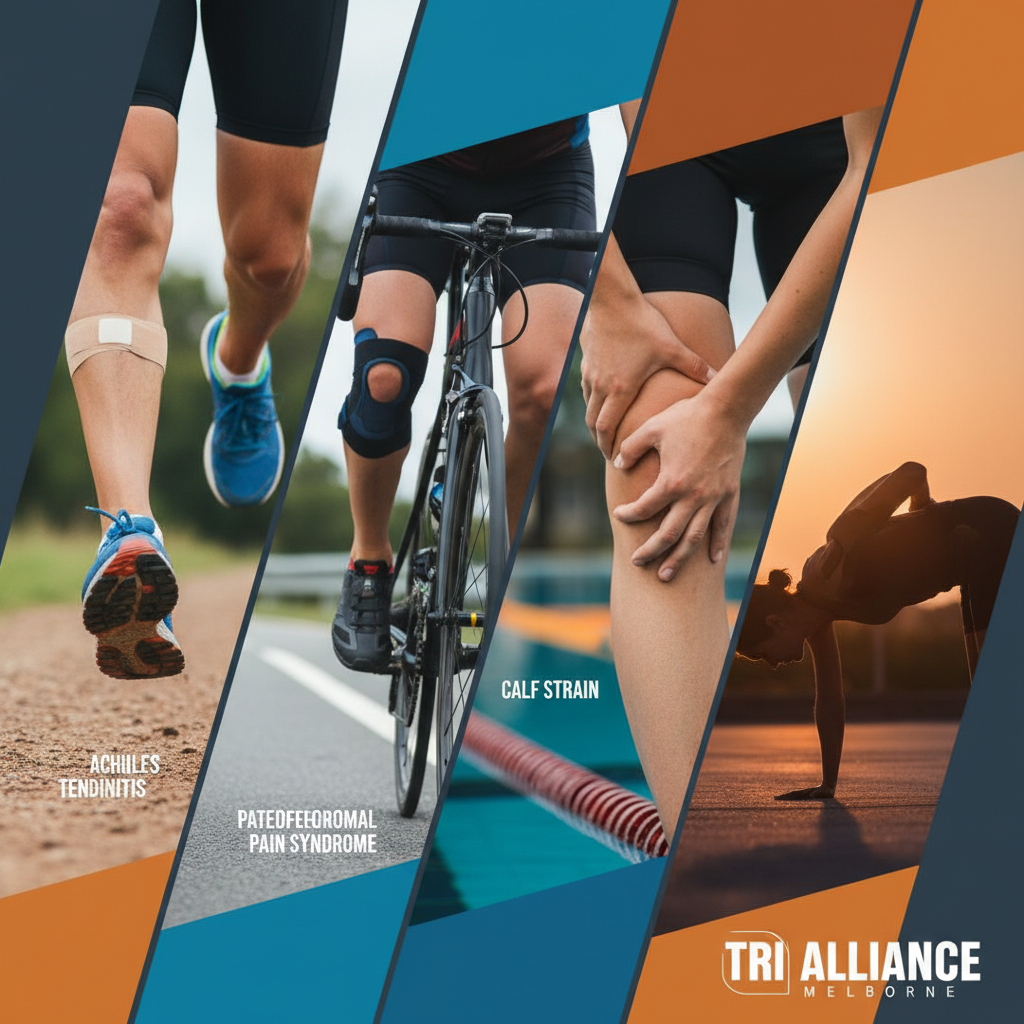
2. Achilles Tendinopathy
The Achilles tendon absorbs forces 6–8x body weight during running. In Ironman athletes who run 40–60km per week, cumulative tendon stress is enormous.
Warning signs:
- Morning stiffness lasting more than 10 minutes
- Tendon thickening 2–6cm above heel insertion
- Pain that warms up during a run but returns worse after cooling down
Recovery timeline: Insertional Achilles tendinopathy: 12–16 weeks. Mid-portion: 8–12 weeks with appropriate loading protocol.
Prevention exercises (3 sets x 15 reps, daily):
- Eccentric heel drops on a step — with straight knee (targets gastrocnemius)
- Eccentric heel drops with bent knee (targets soleus)
- Isometric calf holds at 70° ankle dorsiflexion for 45 seconds x 5 reps (immediate pain relief protocol)
3. Patellofemoral Pain Syndrome (Runner’s Knee)
Extremely common in the run-off-the-bike when glutes are fatigued from 180km of cycling.
Warning signs:
- Aching pain behind the kneecap during or after running
- Pain descending stairs or inclines
- Crepitus (grinding) in the knee joint
Recovery timeline: 4–8 weeks with targeted hip and quad strengthening.
Prevention exercises:
- Single-leg squats: 3 x 12 reps each side
- Lateral band walks: 3 x 20 steps each direction
- Copenhagen adductor holds: 3 x 30 seconds
- VMO-targeted terminal knee extensions: 3 x 15 reps
4. Rotator Cuff Impingement (Swimmer’s Shoulder)
Triathletes who swim 15,000–20,000m per week without technique correction are at high risk. The supraspinatus tendon is most commonly affected.
Warning signs:
- Pain at the top of the arm during the catch phase of freestyle
- Aching shoulder at rest, worsening overhead
- Weakness on internal/external rotation
Recovery timeline: 6–10 weeks with targeted rotator cuff strengthening and technique correction.
Prevention exercises (3 x 15 reps, 3x/week):
- Band external rotation at 0° abduction
- Band face pulls
- Side-lying Y/T/W scapular stability exercises
- Prone swimmer’s exercise with 1–2kg dumbbells
Nutrition for Injury Prevention: Specific Targets
| Nutrient | Target | Key Sources | Role |
|---|---|---|---|
| Protein | 1.6–2.0g per kg body weight | Chicken breast (31g/100g), Greek yoghurt (10g/100g), eggs (6g/egg) | Tendon collagen synthesis, muscle repair |
| Vitamin C | 200–500mg/day | Kiwifruit, capsicum, oranges | Collagen crosslinking for tendon repair |
| Calcium | 1,000–1,200mg/day | Milk (300mg/250ml), hard cheese (700mg/100g) | Bone density, stress fracture prevention |
| Vitamin D | 2,000 IU/day (supplement) | Salmon, fortified milk, sunshine 15–20 min/day | Calcium absorption, bone remodelling |
| Omega-3 fatty acids | 2–3g EPA+DHA/day | Salmon, sardines, fish oil supplements | Reduces tendon and joint inflammation |
Training Load Management
The single biggest predictor of injury in Ironman training is acute:chronic workload ratio (ACWR). When weekly load jumps beyond 1.3x your 4-week average, injury risk spikes significantly.
Practical rules:
- Build for 3 weeks, recover for 1 week
- Never increase swim, bike, and run volume in the same week
- Add a third swim session before adding a third run session
- Track session RPE x duration (AU) — keep week-to-week change under 15%
When to See a Physiotherapist
Do not delay seeking help if you experience:
- Pain that does not resolve within 48 hours of rest
- Any bone pain that worsens with impact
- Swelling in a joint after training
- Night pain
- Symptoms that alter your gait or stroke mechanics
Melbourne athletes can access physio referrals through the Tri Alliance Victoria coaching team, who work with sports physiotherapy partners experienced in Ironman preparation.
Melbourne Ironman Training Considerations
Melbourne’s climate adds specific injury risk factors. Summer training (December–February) in 35–40°C heat increases perceived exertion and running mechanics break down faster. The Tan Track (3.83km loop) is a consistently hard surface — alternate with grass running on Fawkner Park to reduce impact load. Beach Road (Beaumaris to Frankston) is the primary cycling corridor; the constant shoulder position on drop bars for 4–6 hour rides is a primary driver of rotator cuff impingement.
Frequently Asked Questions
How many rest days per week should an Ironman athlete take?
Most experienced Ironman coaches prescribe 1–2 complete rest days per week, with at least one active recovery day (easy swim or yoga). Elite athletes may train 9–11 sessions per week but include daily recovery protocols including cold water immersion, compression, and sleep of 8–9 hours.
Can I keep training with Achilles tendon pain?
In most mid-portion Achilles tendinopathy cases, you can continue swimming and cycling. Running should be modified to pain-free volume only — if pain exceeds 4/10, reduce duration by 50% and substitute aqua running. Never stretch an irritated Achilles aggressively; isometric loading is safer and clinically superior.
How do I know if my knee pain is patellofemoral or IT band syndrome?
Patellofemoral pain is typically diffuse and behind the kneecap, worsening going downstairs. IT band syndrome presents as sharp pain on the lateral (outer) knee at approximately 30° of knee flexion — the “impingement zone.” Both worsen at a predictable distance into a run. A sports physiotherapist can differentiate these in a single assessment.
What is the fastest way to return to training after a stress fracture?
Maintain fitness with pool running (deep water running belt required), swimming, and cycling (if pain-free on the bike). Begin progressive bone-loading at 6 weeks with walking, then 30-second jogging intervals, building over 4 weeks to continuous running. Do not rush this phase — recurrence rates are high when athletes return too early.
Should I use anti-inflammatory drugs (NSAIDs) for Ironman injuries?
NSAIDs (ibuprofen, naproxen) reduce acute inflammation but may impair tendon healing in tendinopathy if used chronically. Short-term use (3–5 days) is reasonable for acute injuries. For tendinopathies, loading-based therapy (eccentric exercises) is clinically superior to NSAIDs as a primary intervention. Never take NSAIDs during an Ironman race — they significantly increase gut permeability and kidney stress under dehydration.
For personalised Ironman training programs in Melbourne, visit vic.tri-alliance.com.au to connect with coaches who structure periodisation to minimise injury risk across your full build to race day.
Discover more from Tri Alliance Triathlon Community
Subscribe to get the latest posts sent to your email.